10.29.2008

The World's Greatest Sinner (1962)


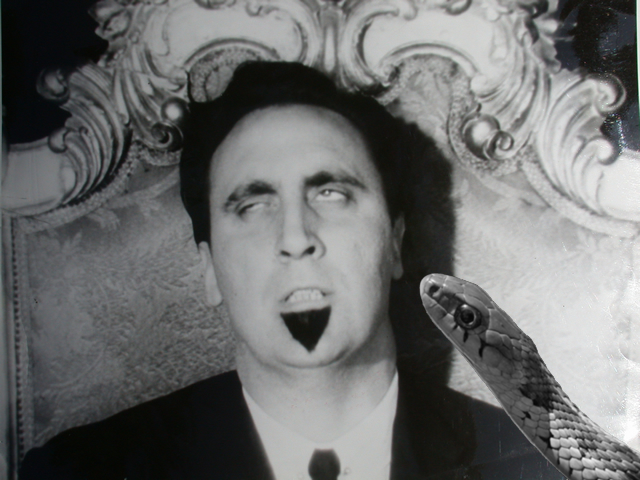
Timothy Carey as GOD, from The World's Greatest Sinner


Most often, I spend the night with myself blushing in the shadows and small lights (I try fetching Bosco Chocolate Syrup but I am out; addictions are sleepy, sometimes like an adventurous song, but my breathing defiance keeps me company in the robes of my meditation, like some heavenly muse) which, the other night, I wasn't. The flaming sepulchres of "karma" lead me towards other routes on my way to the small town where I was born (the Nostalgia still lingers throughout my soul like an undisputed passage, as if my soul could've been lifted from the Earth (comparitely exhausted from Divina Commedia), and several nights ago, partially quieted in the solitude of late night experimentations/observations/film-watchings, &c. in my uncle's room, I was struck by a film that has resonated with me since those nightly-dashings. The "Brilliant, Hypnotic, Startling" The World's Greatest Sinner. I knew that I was rightfully in for a treat when I saw the opening scene of weirdness.
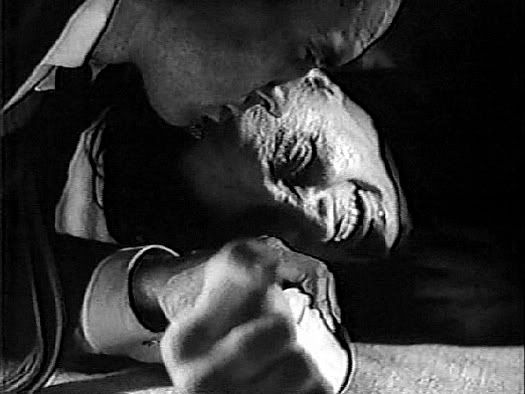


From absolutefilms: (Timothy Carey's) magnum opus, The World's Greatest Sinner, has been called "the best underground movie ever made." Actor-director John Cassavetes said the film had the "emotional brilliance of (Russian pantheon director Sergei Eisenstein)."

"The World's Greatest Sinner is an amazing, love-it-or- hate-it kind of film," says experimental filmmaker Gerry Fialka.

"It's definitely bizarre and in some ways ahead of its time, anticipating the Jim Jones cult many years before it happened. Martha Graham really put it well when she said: The great artists aren't ahead of their time. They are their time! Tim was just reflecting what his times (the late 1950s and early 60s) were all about." The stifling conformity of America in the '50s—the era of the "man in the grey flannel suit"—was giving way to a new, more liberated and permissive society, heavily influenced by the world's first-ever teen culture, with its own music, movies, and values. A rebel himself and no stranger to the Beat Generation, Carey could sense that big societal changes and radical counterculture that would soon shake it's foundations.

It is the story of the mysterious transformation of insurance salesman Clarence Hilliard into a "rockabilly messiah." Clarence quits his job, changes his name to God, and exhorts his followers to become "superhuman beings," working the crowds at his pep rallies into a frenzy! Urged on by a sinister image-maker, God Hilliard parlays his rock stardom into a career in national politics, founding the Superhuman Being Party. His followers wear jet-black uniforms with God's name inscribed on their arm bands. At this point, Sinner becomes a souped-up, low-budget version of All King's Men (1949), a fictionalized account of the rise and fall of Louisiana Governor Huey Long.


Before The Rage of Pricking It With A Needle
attempting to make it bleed (which it eventually does
but much much later that one would expect it to!)


"Sinner was 20 years ahead of its time," says Timothy's brother George Carey, associate-producer of the picture and had a bit part as a follower. Timmy showed it in screening rooms to studio heads, trying to get them interested, but the religious aspect upset them. People who could have advanced the film thought the public would condemn it as blasphemous. But Sinner does conclude with a miracle, a church scene where Clarence Hilliard begs for forgiveness. He has remorse for the type of person he has become, and seeks redemption. The problem was with the blasphemous stuff that came before. Not too many people could handle that."

"My personal opinion is that Sinner is very unusual," Barreto observes. "Nobody else but Tim would have dared to make a movie like that. Very controversial, especially when Tim pierces the host (to make God cry out in pain and reveal Himself).Tim's acting was good, but it was very strange."

I am quite certain that David Lynch saw this film at some point or another before he began making films (or perhaps afterwards -- either way, the influence is obvious). For 1962, as mentioned above, this film was way ahead of its time, and reminds me of many other Black Comedies like The Loved One and Dr. Strangelove or: How I Learned to Stop Worrying and Love the Bomb to name a couple, but this has become my all-time favorite "underground film" which reaches astronomical measures in my opinion and reigns above its past and present successors. To endure the blaze of this masterpiece is one thing, but to actually endure it without pains in the stomach (and partially the brain) is something else. I think I now know those distinct contrasts.
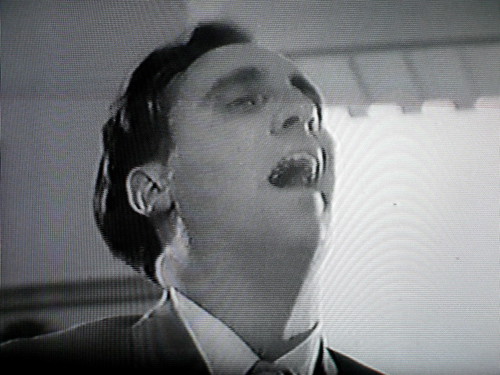


Timothy Carey as GOD from The World's Greatest Sinners


10.10.2008

Sir Thomas Browne's "Pseudodoxia Epidemica, or, Enquiries into Very many Received Tenets, and commonly Presumed Truths"


Sir Thomas Browne (1605 - 1682)

"Vulgar errors," anyone? [Wiki]: "Browne's Pseudodoxia Epidemica contains evidence of his adherence to the Baconian method of empirical observation of nature and her properties. Although often overlooked as an example of the genre of encyclopaedia, Browne, in the preface to Enquiries into presumed Truths, quite specifically defines his written work as an encyclopaedia in the statement,

and therefore in this Encyclopaedie and round of knowledge, like the two great and exemplary wheeles of heaven, we must observe two circles.

Browne's three determinants for obtaining truth were firstly, the authority of past authors, secondly, the act of reason and lastly, empirical experience. Each of these determinants are employed upon subjects ranging from the cosmological to common folklore. Subjects covered in Pseudodoxia are arranged in the time-honoured Renaissance scale of creation, the learned doctor assaying to dispel errors and fallacies concerning the mineral, vegetable and animal kingdoms before moving to errors pictorial, to those of man, geography, astronomy and finally the cosmos."


"Religio Medici" from Sir Thomas Browne's "Pseudodoxia Epidemica"

As another reader commented, as I've researched . . . I, myself, did not come across "Browne's works, by way of the enigmatic final sentence of Borges’s celebrated Tlön, Uqbar, Orbis Tertius, in which the tale's narrator announces his intention to continue revising 'an uncertain translation in the style of Quevedo […] of Browne’s Urne Buriall.'" But, instead, I came upon the works via a reference from Plinies Book of Naturall Histories, in which was spoken of the placement of the human heart in one's chest. From Chapter II:

Of the Heart.

"THAT the Heart of Man is seated in the left side, is an asseveration, which strictly taken, is refutable by inspection, whereby it appeares the base and centre thereof is in the midst of the chest; true it is, that the Mucro or Point thereof inclineth unto the left; for by this position it giveth way unto the ascension of the midriff, and by reason of the hollow vein could not commodiously deflect unto the right. From which diversion, neverthelesse we cannot so properly say tis placed in the left, as that it consisteth in the middle, that is, where its centre resteth; for so doe we usually say a Gnomon or Needle is in the middle of a Dial, although the extreams may respect the North or South, and approach the circumference thereof.

The ground of this mistake is a general observation from the pulse or motion of the Heart, which is more sensible on this side; but the reason hereof is not to be drawne from the situation of the Heart, but the site of the left ventricle wherein the vital Spirits are laboured; and also the great Artery that conveieth them out; both which are situated on the left. Upon this reason Epithems or cordial Applications are justly applied unto the left Breast; and the wounds under the fifth Rib may be more suddenly destructive if made on the sinister side, and the Spear of the Souldier that peirced our Saviour, is not improperly described, when Painters direct it a little towards the left.

The other ground is more particular and upon inspection; for in dead Bodies especially lying upon the Spine, the Heart doth seem to incline unto the left. Which happeneth not from its proper site; but besides its sinistrous gravity, is drawn that way by the great Artery, which then subsideth and haileth the Heart unto it. And therefore strictly taken, the Heart is seated in the middle of the Chest; but after a careless and inconsiderate aspection, or according to the readiest sense of pulsation, we shall not Quarrel, if any affirm it is seated toward the left. And in these considerations must Aristotle be salved, when he affirmeth the Heart of Man is placed in the left side, and thus in a popular acception may we receive the periphrasis of Persius when he taketh the part under the left Pap for the Heart; and if rightly apprehended, it concerneth not this controversie, when it is said in Ecclesiastes; The Heart of a wise Man is in the right side, but that of a Fool in the left, for thereby may be implied, that the Heart of a wise Man delighteth in the right way, or in the path of Vertue; that of a Fool in the left, or road of Vice; according to the mystery of the Letter of Pythagoras, or that expression in Jonah, concerning sixscore thousand, that could not discern between their right hand and their left, or knew not good from evil.

That assertion also that Man proportionally hath the largest brain, I did I confess somewhat doubt; and conceived it might have failed in Birds, especially such as having little Bodies, have yet large Cranies, and seeme to contain much Brain, as Snipes, Woodcocks, &c. But upon trial I find it very true. The Brains of a Man, Archangelus and Bauhinus observe to weigh four pound, and sometime five and a half. If therefore a Man weigh one hundred and forty pounds, and his Brain but five, his Weight is 27. times as much as his brain, deducting the weight of that five pound which is allowed for it. Now in a Snipe, which weighed four ounces two dragms, I find the Brains to weigh but half a dragm, so that the weight of body (allowing for the Brain) exceeded the weight of the Brain, sixty seven times and an half.

More controvertible it seemeth in the Brains of Sparrows, whose Cranies are rounder, and so of larger capacity: and most of all in the Heads of Birds, upon the first formation in the Egg, wherein the Head seems larger then all the Body, and the very Eyes almost as big as either. A Sparrow in the total we found to weigh seven dragms and four and twenty grains; whereof the Head a dragm, but the Brain not fifteen grains; which answereth not fully the proportion of the brain of Man. And therefore it is to be taken of the whole Head with the Brains, when Scaliger objecteth that the Head of a Man is the fifteenth part of his Body; that of a Sparrow, scarce the fifth."


Interesting site-spaghetti to get started, Here.


from Sir Thomas Browne's "Pseudodoxia Epidemica" ('Browne's skull')


10.07.2008

Sol Seppy (my new love)


Sophie Michalitsianos, as Sol Seppy


The Bells of 1 2
is a must-have album. Sol Seppy is my newest addiction. I feel like we know one another. And, well, even in the womb, we are intimately tied to another being, so perhaps we’re merely dancing in the dark in neon red tights.


10.05.2008

The Interesting (and eccentrically-bizarre) Life of Charles Waterton


The eccentric Charles Waterton,
("The man who improved on nature")

Pope Pius VII was extremely annoyed. Some young mischievous Englishman had climbed St. Peter's in Rome and left his gloves on top of the lightning conductor. They must be removed at once. But who would dare to carry out His Holiness' wishes? Sadly, only that same young man had the courage. So Charles Waterton, a good Roman Catholic, penitently reclimbed St. Peter's and brought down his own gloves.

That, ladies and gents, was in 1817 when Mr. Waterton was 25 years of age, and this was the first time he caught the public eye. He then went traveling in the West Indies and North and South America, observing wildlife, collecting birds, and eventually writing a bestselling book on his travels in Latin America and the natural history of the region, on which he became the acknowledged expert. Again, he showed his physical courage. In South America, Mr. Waterton caught an alligator by riding on its back and seizing its front legs. Helpless in this judo-hold, the animal was dragged ashore. Later he cut its throat and skinned it.

On one of his expeditions, as an experiment he tried to get a vampire bat to bite his big toe by sleeping with his foot dangling out of his hammock. However, the bat then ignored him, choosing instead to bit his native servant. When he returned home to Yorkshire, he built a 9-foot-high wall encircling 3 miles of his estate, making it one of the world's first wildlife sanctuaries.

His interests as a naturalist had made him an accomplished taxidermist, and he built up a whole museum of stuffed birds and animals. But, of course, he was not content with animals as nature had created them. He took different parts of birds and animals and amalgamated them into his own monsters. In the case of his celebrated Nondescript, he contorted the face of a red howler monkey, convincing many people that he had stuffed a human head (see image below). To many of these homemade monsters he gave the names of some well-known Protestant personalities. But, this was not his only eccentricity: -- One of his favorite pranks was to hide under a hall table until a guest had put down his coat, in which he then leaped out to bite the astonished visitor.

After the death of his wife, he slept on the bare floor with a block of wood for a pillow. He rose at 3am on each day and spent the time before breakfast at 8am reading and praying. Then he would spent the rest of the day studying wildlife. When he was over 80 (he lived to the age of 83) he would shin up trees to examine birds' nests. He scrambled up "like an adolescent gorilla," according to a contemporary.

One of the eccentric squire's projects was the construction of a flying machine. It took a great deal of persuasion by his friends and servants before gave up the idea of testing the machine by leaping from an outhouse roof. It was this kind of unusual activity that brought about his death in 1865 when he fell while carrying a huge log, dying of his injuries 10 days later. He was buried with great ceremony, and a fleet of funeral boats escorted his body across the lake on his estate.

Thanks to Charles Waterton, wildlife preservation societies are going strong today. I've also come to the realization that I would love to someday make Charles Waterton's life-story into a film.


Charles Waterton's famous Nondescript.


10.04.2008

"PURPOSEFUL PURPOSELESSNESS" -- (quotidia Cage)


Are you alone in the world? Give him time to eat. Nice warm milk makes the body feel so relaxed. A chief disaster of removing. No animal is unnamable. Nothing is innamable.

Innamable / Mammal / Shambles

Ham sandwich / Rubbery / Duckling / Circus

Nonsense! I insist! My, it looks as if it ’s going to storm. A human kindness is all -- that ’s all it is! Would you like to stop your partner ’s snoring?

Works like a charm. I declare! To complete the identification! On the double, let ’s go! There is no truth. The truth, your truth, is nothing more

than an off-the-rail freight train. Something running through the undergrowth. Wasn ’t really wise, either. A lot of high-strung people around here.

Building up grudges. Occasionally ceased by the compulsions, a pathological distortion. Insane, sane, it ’s only Balance. Mischievous child.

She ’s on edge; a particular state of mind. Theories in abnormal behavior. You make the most peculiar compliments. French melodies.

non-Moonlight Sonata. There ’s a sort of non-sorrow in them. Human predicament. Loneliness. Moving about in a region of horror.

It ’s frightening sometimes how you know people. Some people don ’t remember parts of their lives. Liberal exhibitionism.

“Holier than thou attitude.” Bed-ridden. To have a missing button. Signed confessions. Feeble-minded individuals. No obligation.

+ “They only write fairytales to keep children out of mischief.”
+ “Yes, and the children never listen, do they?”

HE X I TO N E.

Many things sounding like a Freudian conflict. I ’ve noticed that people ’s hands get heavier when they get married, but often times the weight on those hands take part in newer residences.


9.27.2008

Jeremy Brett, definitive Sherlock Holmes


Jeremy Brett as the definitive Sherlock Holmes

Sherlock Holmes. The name alone (for those whom are aware of it) typically strikes up such words as "mystery," "murder," investigations," and even "daft geek" for those like me whom are contributingly-fanatical, and "I have a tendency to overreact a little, and am often guilty of flippancy" amidst these sorts of things (eg: Pink Floyd, Mary Shelley, Poetry and "Language" in general, &c. --); a bit of a dogmatic-mushroom that grows out of my eyesockets -- the kind that one can step on, exploding plumes of smoke arising about the air afterwards. Perhaps I may be guilty of over-dramaticism, as well, admittedly operant and a bit woundy, but even sometimes the Sharpie "runs out" and becomes like a dormant, dead, clanging watch. In the wafture of my lingering interests, I often find myself in a bit of "dumb amazement," vailing amidst it all like some triumphant zephyr floating away in a roar of ustulation.

Thanks to Sir Arthur Ignatius Conan Doyle, I've been a regular vignetting aligned in such a masterful collection of delicious tales. I recall the memory of reading my first Sherlock Holmes adventure ("A Case of Identity," I believe it was) and was rather decorum'd with a strangehold of such eccentric-wit and mystique that I haven't turned back since. I discovered The Adventures of Sherlock Holmes "years ago" (which seems like a repetitive phrase in my reach), or, perhaps I shall say that I was "introduced" to it by my wondrously-entertaining uncle, who had been watching the series since the '80's when it originally began airing. I was awe-stucken from the initial beginning with Jeremy Brett's portrayals as the-one-and-only. As one reviewer aptly and gorgeously put it, "Nothing before or since quite matches Brett's mercurial portrayal. It is exquisite. Not only is it the best representation of Holmes, but one of the most consistently mesmerising performances by any actor on any television production. Brett's diction perfectly suits Holmes's precise, logical mind; each word is said so perfectly that we are spoiled by eloquence and we hang on every word, the modulation that suddenly lifts to emphasise one word over another, to make revelations about an investigation or to reach into Holmes's melancholy." And further, "Under Brett, Holmes is arrogant, sly, misanthropic, pondering, but also vulnerable, empathetic and fragile. It is a human Holmes, but one still tantalisingly removed from most of us in his genius for linking disparate clues — ash in an ashtray here, a footprint there — to solve a mystery. It is this ability to hold together all the contradictions native to Sherlock Holmes that makes Brett's portrayal so compelling."

One of my favorite episodes has to be the "The Devil's Foot"; a particular adventuring quip of psychedelic-madness and bizarre events that provides one of the most memorable scenes of the entire show, in my opinion (though only lasting a little over one minute, but well-worth the waiting rabbit's tap) where Holmes begins hallucinating ("In the Granada Television version starring Jeremy Brett, a sequence is added showing Holmes burying his cocaine syringe in the sand during a walk on the beach. Apparently Jeremy Brett had become concerned about his character's drug habit, sought and received permission from Conan Doyle's heirs to have Holmes give up the habit. Also, the Granada version shows Holmes' hallucinations when exposed to the Devil's Foot poison. Holmes has visions of his parents and of Professor Moriarty in this sequence before being brought back to reality by Watson. When Holmes is reveived he calls Dr Watson by his first name "John.""). Naturally, every episode is worth viewing; I tend to want the entire DVD set, but right now the Presidents on the bills of U.S. dollars all mock me with the most insane of laughter, and considering that the "list is never-ending," I have a backlog of cracking walls waiting for a sandbag or two, so time will only tell. Luckily the shows are still televised.

(Other interesting information to note: The phrase "Elementary, my dear Watson" is often abstractly-attributed to Sherlock Holmes. However, nowhere in any of Doyle's books does Sherlock Holmes ever utter these oft-quoted words. As studied, the closest that Mr. Holmes comes to speaking these particular words is in the story "The Crooked Man," where, in the story, Dr. Watson [Holmes' former assistant, of course] has married and no longer lives with Sherlock at his flat at 221B Baker Street, London. When Holmes calls on Watson to ask for his help in solving a mystery, he makes a few deductions about his old friend. He observes, for example, that Watson still smokes the same pipe tobacco [from observing the ash on his coat] and that he is very busy. Watson then asks how Holmes knows this [which you think he would know better to ask such a silly question; this is Sherlock!] in which Holmes replies that Watson takes a hansom cab when he is busy and walks when he is not. Watson's boots are dusty enough to have been outdoors, but not dusty enough to have been out walking. Therefore, Holmes says, he must have taken a ransom. Therefore, he must be busy. "Excellent!" blurts Watson. "Elementary," says Holmes.)


Jeremy Brett, Sherlock Holmes


9.24.2008

Pulling From Inout The Brain & Other Daring Voyages


MACRO FUTURE: Into Me, Out of Me

Sometimes my television glows in the night even though it hasn't been switched on for days. Often times, in the same bank of strangeness, my computer printer switches itself on without any regard for my own paranoid jumpiness (nor any actionable splinters), in which case I engage in cooling off after a few seconds; my gradualism in flames of ghastly curiosity. The rock is solid. So, so solid . . .(not "in the flames of withering justice.")

In H.W. Fowler's The King’s English:
"Among other arts and sciences, that of lexicography happens to have found convenient a neologism that may here be used to help in the very slight classification required for the new words we are more concerned with—that is, those whose object is literary or general, and not scientific. A 'nonce-word' (and the use might be extended to 'nonce-phrase' and 'nonce-sense'—the latter not necessarily, though it may be sometimes, equivalent to nonsense) is one that is constructed to serve a need of the moment. The writer is not seriously putting forward his word as one that is for the future to have an independent existence; he merely has a fancy to it for this once. The motive may be laziness, avoidance of the obvious, love of precision, or desire for a brevity or pregnancy that the language as at present constituted does not seem to him to admit of. The first two are bad motives, the third a good, and the last a mixed one. But in all cases it may be said that a writer should not indulge in these unless he is quite sure he is a good writer.

The couch-bunk under the window to conceal the summerly recliner.—Meredith.


The adjective is a nonce-sense, summerly elsewhere meaning 'such as one expects in summer'; the noun is a nonce-word.

In Christian art we may clearly trace a parallel regenesis.—Spencer.

Opposition on the part of the loquently weaker of the pair.—Meredith.

Picturesquities.—Sladen.

The verberant twang of a musical instrument.—Meredith.

A Russian army is a solid machine, as many war-famous generals have found to their cost.—Times.


Such compounds are of course much used; but they are ugly when they are otiose; it might be worth while to talk of a war-famous brewer, or of a peace-famous general, just as we often have occasion to speak of a carpet-knight, but of a carpet-broom only if it is necessary to guard against mistake.

Russia's disposition is aggressive ... Japan may conquer, but she will not aggress.—Times.


Though aggress is in the dictionary, every one will feel that it is rare enough to be practically a neologism, and here a nonce-word. The mere fact that it has never been brought into common use, though so obvious a form, is sufficient condemnation.

She did not answer at once, for, in her rather super-sensitized mood, it seemed to her...—E. F. Benson.


The word is, we imagine, a loan from photography. Expressions so redolent of the laboratory are as well left alone unless the metaphor they suggest is really valuable. Perhaps, if rather and super- were cancelled against each other, sensitive might suffice.

Notoriously and unctuously rectitudinous.—Westminster Gazette.


Some readers will remember the origin of this in Cecil Rhodes's famous remark about the unctuous rectitude of British statesmen, and the curious epidemic of words in -ude that prevailed for some months in the newspapers, especially the Westminster Gazette. Correctitude, a needless variant for correctness, has not perished like the rest.

We only refer to it again because Mr. Balfour clearly thinks it necessary to vindicate his claims to correctitude. This desire for correctitude is amusingly illustrated in the Outlook this week, which...—Westminster Gazette.


All these formations, whether happy or the reverse, may be assumed to be conscious ones: the few that now follow—we shall call them new even if they have a place in dictionaries, since they are certainly not current—are possibly unconscious:

The minutes to dinner-time were numbered, and they briskened their steps back to the house.—E. F. Benson. (quickened)

He was in some amazement at himself ... remindful of the different nature...—Meredith (mindful)


Remindful should surely mean 'which reminds', not 'who remembers'.

Persistent insuccess, however, did not prevent a repetition of the same question.—Times. (failure)

The best safeguard against any deplacement of the centre of gravity in the Dual Monarchy.—Times. (displacement)

Which would condemn the East to a long period of unquiet.—Times. (unrest)


Mere slips, very likely. If it is supposed that therefore they are not worth notice, the answer is that they are indeed quite unimportant in a writer who allows himself only one such slip in fifty or a hundred pages; but one who is unfortunate enough to make a second before the first has faded from the memory becomes at once a suspect. We are uneasily on the watch for his next lapse, wonder whether he is a foreigner or an Englishman not at home in the literary language, and fall into that critical temper which is the last he would choose to be read in.

The next two examples are quite distinct from these—words clearly created, or exhumed, because the writer feels that his style requires galvanizing into energy:

A man of a cold, perseverant character.—Carlyle.

Robbed of the just fruits of her victory by the arbitrary and forceful interference of outside Powers.—Times."


The inevitable suggestion, a huge mass of puffs and joints that sweep me by never go unlooked. Neologisms have been a part of me since my birth, like Indians in Okie Prisons many years ago. I remember the windows and how words were lead-colored on my tongue, like an "endless grey carpet of seabirds." To be translated into an uncharitably-received message on one side of the coin (Dylan: "The picture you have in your mind of what you're about ... will come true. It's kind of a thing you kinda have to keep to yourself. It's a fragile thing and if you put it out there, somebody will kill it, so it's best to keep that all inside. . .") to find the other coin, with age (with wisdom) comes from a point in ones life where, in my K-grade days, I read repetitively-fast in my circle of fellow classmates, often raising my hand more-so than others. I felt like a beautiful vase on a stone terrace, over-looking a sea of words (especially when the other students were reading; I'd have to often let my mind wonder about, losing my place in the text, because of the certain struggling woes of others, in which I'd attempt to 'correct' more-so than the teacher). Sometimes I wish I were a child again (physically) - a melody of flowing wind . . . a vague break in a dance-move, and a scattering of song (though my stage-fright was terribly phobic-like).


Stan Brakhage: "Window Water Baby Moving"


9.23.2008

The Squabbly-wobby Psyche-"Meridian" & Abstract Quixioms


PINPOINTED: An ancient Chinese acupuncture chart
that shows
some of the positions of some of the 900 needle points on
the network
of "meridians."


I've been reading about ancient Chinese acupuncture and things like "the placebo effect" (low-pain perceptions - do the "meridians" need to be philosphize'd into a debatingly-undebated response for those with "normal" versus "abnormal" perceptors?) and I began pondering several ways to "enhance" my prickled-mind towards the development of several "take-offs" (un-rocketeering, tho, NASA-lipped and crumbled; perhaps more like Tarkovsky's Solaris) on my "screen name," (which, an educated voice would possibly spatter, A Book of Changes!; no confusion on "I Ching") and I have come up with several needle-pointed landscapes to acquaint my opencast reel ("arranged like the layers of an onion"):


Derrick(T)autochrone

Derrick(T)eetotum


Derrick(T)herianthrope


If I were like "The Self-Dismembered Man" that Guillaume Apollinaire erupted into (or (...)) then I shabby to think

that the following thoughts would collaborate with a kind of rising vapour into "drinking the youth" of the pain threshold.

Truth is, "The magic pink seashells" (as British UK psychedelic band Kaleidoscope would reverberate many years prior) of my exploding mind

have apparently just been sitting out in the sun of cinema for far too long. KRS-One, in 2003: When asked about the future of hip-hop he said,

“Our day is coming. It's inevitable that the president in another five years will be a hip-hopper. The mayor of Chicago will be somebody

who has grown up on N.W.A., Chuck D, even Lil' Kim and Foxy Brown. All of it will make sense then.” Dora Maar: “Pure as a lake boredom.” (transparent-alert!)—

War empties pockets or does war familiarize itself with knowing? Perhaps the pith of this unbalanced equilibrium would be in the intelligence of KRS;—

Obama? Are you a hip-hopper? Grasshopper? A lesion of deceit? 21st Century Huang Ti? Ol' Yeller or, as stated, the "Yellow Emporer"? It appears as tho

my black, sweet tea isn't going down the drain (something of which could be measured as morbidly-brooding) as swell as

I'd like the operation to go (PJ Harvey said it best: "This Mess We're In"). I'll be the Mummer at the voting booth . . . perhaps I'll find something to boost / er me . . . and in the end,

marwodd yn ddiepil is a hopeful gushing outpour to keep the toezies and fingerzies crossed. The light, "so pretty in white." Yes. Now imagine

the multitudes of individuals whom were quite doubtful in regards to the ancestors of these creatures; Woolly Mammoths that often showcased their strengths

upon the Dicearchuses of the world in those days. Of course, that is, depending on the rotundas of the world in which people

may believe in the world as being "millions of years old," which I don't, but it's the myths that make it all so-very fun and imaginative. Peter Falk could be a dinosaur

for all we know. (He has the anger downpact; revisit his madness as Robert Evans (1962) on The Alfred Hitchcock Hour . . . "Bonfire" ["too much juice of the grape" crackles my insides]).

And, most "embarrassing moments"? An Ugly Man Contest in '57, '61 and '63.


"This Ugly Man was quoted in the 1963 Savitar as saying,
"She said that I wasn't exactly her Rock Hudson image."
(A stab at
Rock Hudson in the brilliant film, "Seconds," as I have showcased before)


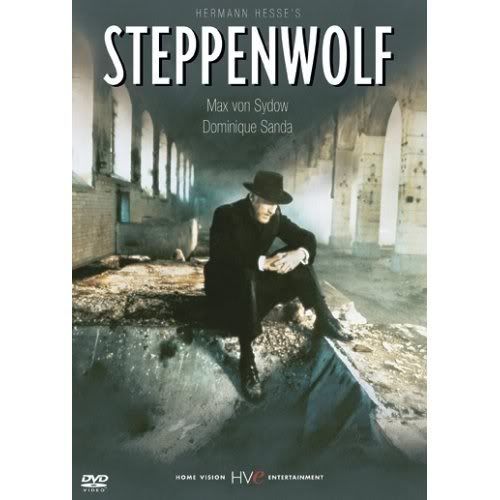
Steppenwolf (1974)

"The struggle of the human mind ... against itself."

Herman Hesse's "Steppenwolf"


Herman Hesse's brilliant novel, "Steppenwolf"

Several moons ago, however you'd like to label my past filmic leash of tugging, I was introduced to Herman Hesse's Steppenwolf, which, as most people are quite familiar with by now, is also a popular rock 'n' roll band (that lifted the name from the novel, of course, as if they couldn't be more original!). Unfortunately, the band is far more "known" than Herman Hesse's novel, but if I could take the two and stir them together, there really are no recurring similarities, unless one wants to familiarize the psychedelically-solarized scenes of the "Magic Theatre" from the film (which is essentially a bonus snack at the end of of the flick) with the band's song "Magic Carpet Ride," then that may have some merit, because, all in all, one is most certainly taken on a ride amidst the cinematic gulps and nibbles there, as well as within the book.


Steppenwolf, starring Max Von Sydow

Rarely does a film ever stay true to the contents of the story that it is being created from, but apparently Fred Haines wanted to do it "right" and thankfully for us dogmatic ones, we were served with a delicious feast. From Wiki: "The film made heavy use of visual special effects, which were cutting-edge at the time of its release in 1974." I would suggest reading the book first and then watching the film so that you can compare as you follow. This particular film, along with BBC's 1977 Count Dracula (starring Louis Jourdan), are two of the most faithful adaptions of book-to-film releases that I am familiar with, and both are well-worth venturing into ... of course, if you like this kind of madness as I do.

As The Hitch would spout, I think I'd better be trodding off. I just decided to have my head sanforized. Good night.

Steppenwolf (1974)

This film (starring Max Von Sydow as the Steppenwolf) is in my Top 10. One of the most underrated films of all-time (and the most bizarre, I do say) based on Herman Hesse's great novel.

6.17.2008

The Other "Mona Lisa" and Ponderings of "Abstract" Art:

PORTRAIT OF A PORTRAIT: This sketch, by Raphael,
was made while Leonardo was still working on his
masterpiece. Several features, such as the two columns,
are similar to the painting ("London's 'Mona Lisa'")
kept by Dr. Henry Pulizter in London.

As most are familiar, one of Da Vinci's "trademarks" and distinct characteristics in which made his work stand out in an iconic fashion, was that he held his paintbrush in his left hand and would often times smooth in the paint with his right hand to achieve a particular effect. One way in which one is able to authenticate his work is by looking at his fingerprints that would often show up very clearly in the paintings. That being said, experts have compared other prints on a version of the "Mona Lisa" jointly owned by a Swiss syndicate and London scientist, Dr. Henry Pulitzer, with those prints on the other Da Vinci paintings, and, of course, the verdict was out! The painting that was in the possession of Dr. Pulitzer is an authentic Leonardo, a portrait of Mona Lisa del Giocondo.


LONDON'S "MONA LISA": A version which bears
fingerprints that match up with those on other
authenticated paintings by Da Vinci. It is thought to be of
Mona Lisa del Gioconda, while the Louvre version is of
Costanza d'Avalos, "La Gioconda."


Backtracking
a bit: I've always found interest in paintings that are shrouded in controversy, whether it be Oriental art, abstract art (especially that of "The Flowering of San Francisco" artists of the late 50's and early 60's), surrealism, Cubism, &c., whatever the "style" may be, interests me for the mere fact that, not only does my imaginative juices begin flowing, but my writing juices, as well. Of course, after studying one of the strangest paintings in the world, The Mystery of Mad Maggie (. . .as it's often called, though bears no "true name" — but the name of which it is acquired came from the earliest historian of Flemish painting, Carel van Mander, writing one generation after it was painted, called it Dulle Griet, which means "Mad Maggie". . .)

I realized that every image tells a story, and most usually, typically, suffers no loss of "mystery" (often considered by "non-understanders" labeling artists as raving lunatics, and fair enough!). Infinitely surprising to me is the notion that every object has to be "labeled" into a certain stimuli or nucleus before our brains can react from it with what we "know" from learning about it (elongated by the ''mathematics of communication'' - and we all know that we can and do enjoy certain sequences of quite abstract SOUNDS, [in this case, as an example] PATTERNS of pulsation of the air that we are almost devoid of human content). To me, everything is abstract in its own right; it's own existing mass. It's merely all how it's looked upon, and later, I will speak more about why "realistic art" and "abstract art" (as being said, the two offer no real logic as what should be debated as a particular art-form that is more superior to the other) can exist in the world side by side, even with one artist at the same time.

So, as I have been swept into another orbit (seeking an uprooted exploration); back to controversies and aesthetic expressionism ("Let no man under-value the implications of this work, or its power for Life — or for death, if it misused" — and what of the "now"; the "spirit of the place"?!) of Da Vinci and the false Mona Lisas.

The face of the "Mona Lisa" smiles mysteriously down, if you've ever noticed, and not only from the Louvre in Paris, but also from various walls (to this day, being carried around like a wallet, it would seem, or at least its "history" would speak of such). The latter, if you will, said by Pulitzer, but a completely different version by Da Vinci and his studio. And while there are more than sixty "alleged" Mona Lisas catalogued throughout the world, Pulitzer was most certain and positive that his own painting was of pure authencity.

Da Vinci, as he would point out, habitually did two or more versions of his portraits. The original sitter was Mona Lisa del Giocondo, who, at the time, was mourning the death of her baby daughter and wore a transparent veil during the sittings. Da Vinci spent fours years on the painting and he eventually left it with the Giocondos. Then, shortly before he went to France, at the invitation of Francis the First, Guiliano de Medici asked him to paint a portrait of his current mistress, Costanza d'Avalos. Coincidentally, Costanza not only resembled Mona Lisa ever-so-slightly, but was also nicknamed "La Gioconda" (which means "Smiler"). Da Vinci adapted his alternative version of Mona Lisa del Giocondo's portrait, turning the fact into that of Costanza. But, no sooner had he completed the work, Medici decided to drop his mistress in favor of a profitable marriage (good boy!) and so did not buy the picture from Leonardo after all. It was the second portrait, as Pulitzer had stated, that Da Vinci took with him, along with all of his other unsold works, to France. It is this version (of Constanza) that Pulitzer maintains, that graces the walls of the Louvre (or did, anyhow).


NUDE GIOCONDA: There were more than
60 alleged Mona Lisas, as is known, and here,
a seminude portrait of "La Belle Gabrielle,"
which is currently in the collection of Lord Spencer
of Northamptonshire, England,
and is "attributed to the school of Da Vinci."


In what case can be made that everything is abstract? To separate the two, firstly, would be silly. Secondly, there shouldn't be any other unequated progress that art should "stand alone" in one box, while every other label, mold, caricature, expression, dialect, critique, &c., &c., tries to dig that one particular thing out of the box to try and split it apart like a pecan. What lies inside that isn't as natural as we come to make of it? This isn't, of course, to decry the learning of various procedures and styles that are derived from the creative-forms of art, but to simplify it, as has been argued, to being something of which is subjected to that of one surface'd aspect of alienation, to me, is bland (the old attage, "everything is art," just as "everything is abstract," just as "everything is avant-garde," and so on. . .).

The artist must impose some of oneself and one's ideas on the material, in a way that uses the material sympathetically, but not passively. Otherwise, you are are only behaving like the waves. There essentially must be a human imprint and a human idea.

Some people think that some abstract art is mistaken. However, all art, as said, is abstract in one sense. Not to like abstract qualities or not to like reality is to basically misunderstand what art is all about. Some artists are just more "visual," or get more excitement from nature in front of them, and they make a work of art from that. Certain other individuals do it from their insides; perhaps with a more "mental approach"; the actual image-making or image-designing can be an exercise disconnected from a relationship with the "outside world."


Every Portrait is always connected with another Portrait:
Here, "Coffee" by Richard Diebenkorn, 1959

Rosemary Brown: Music From The Immortals (Fraud or Medium?)


Rosemary Brown, transcribes music from deceased Composers?

After pondering (for a few days now) almost single-mindedly the notion that perhaps we are all in the sky before we are born, the fact that we could very-well be derivatives of the Giant of the "beanstalk," tossed down to earth after our ruptured births, the very tedious and untedious and imaginatively-focused buzzing in my mind—the fact that we may very well land on cardboard boxes with soft blankets inside for comforting our newly-fresh bodies—the imagination had me swinging open the revolving-doors of my mind towards other "spiritual" things (perhaps even a promiscuous folly of sorts, beyond the groupuscules and mascots), all-the-while, as will be said, all characterized by a certain ambiguity between interiors and exteriors with regards to what one wants to believe versus what, and where, the Reality is fastened in one's hula-hoop of idealogies and sophisticative-"thinkership."

With such a broad and somewhat silly notion (depending on what one wants to consider "silly"), I had recalled a memory in which, after listening to various classical music pieces for the evening, had linked my Birth-ideas of imaginative story-telling with other spirit-mediums (which I often find to be completely demonic, more than "ghostly"), and this time, with a fascinatingly-interesting story that has always held speculation (Dave Von Kleist: "If you're not on somebody's watchlist, you're not doing your job"), as with any subject, whether broad or shrinkable, the peculiar (and very obscure) story of Rosemary Brown (27 July 1916 - 16 November 2001), who "was a spirit medium who claimed that dead composers dictated new musical works to her. She created a small media sensation in the 1970s by claiming to produce works dictated to her by Liszt, Brahms, Bach, Rachmaninoff, Schubert, Grieg, Debussy, Chopin, Schumann and Ludwig van Beethoven."

Dead musicians that she communicated with providing her with "unwritten" pieces of music for her to learn and to perform? How uniquely-refined (and shaped) I had thought—this immediate fascination with perhaps a perfect blend of drawing attention and making oneself feel empowered by creating controversy? Then again, where else would the "proof" come from if it weren't right there before our eyes?

From a selection in her autobiography, Rosemary wrote:

"The first time I saw Franz List [sic] I was about seven years old, and already accustomed to seeing the spirits of the so-called dead. For some reason he never said who he was that morning. I suppose he knew I would eventually see a picture of him somewhere and would recognize him . . . He then said: ‘when you grow up I will come back and give you music.’"


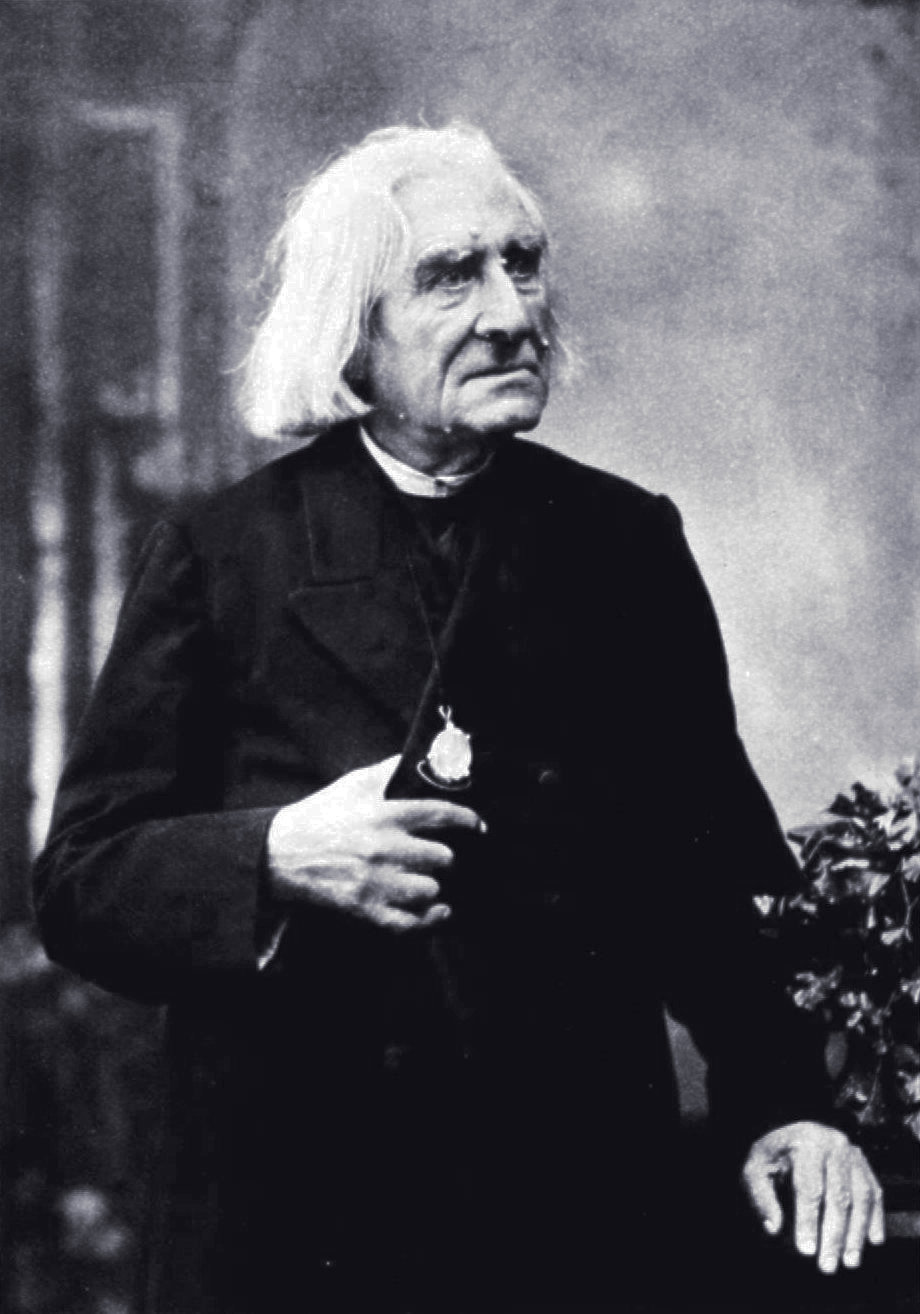
Franz Liszt


When Igor Stravinsky appeared to Rosemary 14 months after his death and dicated 60 lines of music, she was not surprised. For he was, she said, the 20th dead composer or author to use her extraordinary talent.
It was only at the age of 7 that she was introduced to the "wonderful world" of dead musicians (imagine!). A spirit with long white hair and a flowing black cassock appeared and told her he was a composer and would make her a famous musician one day (perhaps an angel?). Rosemary basically didn't have any idea who this "ghost" was until around 10 years later when she saw a picture of none other than Franz Liszt.
Rosemary's Mother and Grandmother were both psychic (although I personally don't believe in psychics) and she had supposedly told her parents of events before her birth, and when she was asked how she could know, she would reply that her "visitors" had told her. Listz, being that it may be the case, wasn't one of these "visitors," and in fact, he didn't appear to her until 1964. By this time, Rosemary had married and raised two children, while living in a beautiful Victorian terraced house in London; not to mention the fact that she was now a middle-aged widow.

Before 1964, she paid very little attention to music and had had very minute and small amounts of "instruction" in it. In fact, after the war had subsided, she purchased a second-hand piano and began taking lessons for about a year, even though many people were thoroughly not impressed by her "playing skills." Then, suddenly, in 1964, Liszt returned and "renewed" his "contact" with her, and original compositions began flooding in from a random-array of great musicians of the past. Rosemary transcribed these pieces from Beethoven, Bach, Chopin, Schubert, Rachmaninoff, and, of course, Listz himself (all of these as previously mentioned before). Of these included a 40-page Schubert sonata, a Fantasie Impromptu in three movements by Chopin, 12 songs by Schubert, and 2 sonatas by Beethoven, as well as his 10th and 11th Symphonies (both of them unfinished).

Apparently each composer had their own "special way" of dictating to Rosemary. Liszt, for instance, "controlled her hands for a few bars at a time, and then she wrote down the notes." Others, such as Chopin, "told her notes and pushed her hands onto the right keys." Schubert, is said to have tried to sing his compositions to her, but she stated that it was impossible for her because he didn't have a very good voice. Beethoven and Bach "simply dictated the notes, a method that she disliked since she had no idea of what the finished product would sound like." From the source, it states that they all spoke to Rosemary in english, which, as she says, didn't surprise her whatsoever: "Why shouldn't they have gone on learning on the other side?" she asked. However, when agitated, "they were liable to relapse into their native tongues" in which Beethoven would often spout Mein Gott! when they were perhaps hard at work and the doorbell would ring, disturbing the dictations.

Here and Here are two wonderful, wonderful sites in regards to it, in which you can actually hear some pieces from these so-called Transcribings!


Rosemary Brown

______________________________________________________________________
Criticism: "The opinions of musical critics were varied on the merit of Rosemary's transcriptions. But most agreed that in their style they bore a great resemblance to the composers' published works. Forgeries and imitations had frequently been made in the past, but considerable musical knowledge is thought to be required for this. Mrs. Brown maintained that she had never had any musical training aside from a few piano lessons. It was suggested that she may have had advanced musical training but then forgotten it in a bad case of amnesia. This suggestion was, however, described as preposterous by the Browns' family doctor. Brown's musical skill was such that she was unable to play many of the pieces she claimed had been dictated to her. Rosemary was thoroughly investigated by both musicians and psychologists. None could find any way in which she could be cheating.

Other explanations were put forward. One was that the composers had left behind them unknown, written music and that Rosemary was able to read these sheets, unwittingly using a form of telepathy.

Another suggestion was that she picked up music from people around her by telepathy. However, she did not spend her time in the company of musicians who might have been composing works in the manner of Bach and Brahms.

Of the music itself, Richard Rodney Bennett, the British composer, said: "A lot of people can improvise, but you couldn't fake music like this without years of training. I couldn't have faked some of the Beethoven myself."

Hepzibah Menuhin, the concert pianist and sister of Yehudi Menuhin, was also impressed. She insisted: "There is no question but that she is a very sincere woman. The music is absolutely in the style of these composers."

Alan Rich, music critic of New York magazine, took a different line. Having heard a privately issued record of piano pieces allegedly by the spirits of several dead composers, Rich concluded that they were just sub-standard reworkings of some of their better-known compositions. In 1969 she was put to a test by the British Broadcasting Corporation, who set her at a piano where she waited for the spirit of Liszt to appear to her. In due course she produced a piece, supposedly dictated by Liszt. As it proved too hard for her to play, another pianist was engaged to play it. The piece was subsequently studied by a Liszt expert, who said it had definite similarities to the great composer's work. A recording of some of the music produced by Brown (The Rosemary Brown Piano Album) was released, and various books by her (including Unfinished Symphonies: Voices from the Beyond) were published."

6.16.2008

Superman with eyes of a devil?


Spring-Heeled Jack, Leaping Away


In southwest London, mid 1830's, what was once a "rumor" for the most part had quickly became terrifyingly-confirmed in February of 1838, about the persisting reports of a leaping, bounding superman who was an alarming figure that flew through the air in great leaps across many paths. To most, naturally, it would seem like something out of one's highly-equipped imagination, but apparently this spring-heeled creature was more than that, and became something of a legendary tale.

Jane Alsop was young and pretty. She lived with her two sisters and their father on a London back street. She had heard of the bogeyman called Spring-Heeled Jack, but she was too "sensible" to heed such tales.

One night there was a violent knocking at the door. Jane went to answer it. The man standing in the shadows near the front gate swung around, blaring, "I'm a police officer!" He went on, "For God's sake, bring me a light, for we have caught Spring-Heeled Jack in the lane!" Jane thought about this for a moment: "The stories were true after all." She ran off to fetch a candle. "I'll see him being arrested," she thought, as she rushed back outside with the candle. But, as soon as she gave the man the man the candle at the gate, he grabbed her by the neck and pinned her head under his arm. Then he ripped at her dress and body. She screamed and tore herself away. He chased her, caught her by the hair, and clawed her face and neck. Her sister, hearing the screams, ran into the street and cried out for help. But before anyone could stop him, Jack soared away into the darkness.

Jane later described her inhuman attacker to police officials. "He was wearing a kind of helmet," she had told them, "and a tight-fitting white costume like an oilskin. His face was hideous, his eyes were like balls of fire. His hands had great claws, and he vomited blue and white flames."

This description that Jane had given was repeated over and over again in the following years. Always the leaps, the flames, and the eyes of hell were recounted. Lucy Scales, 18 years old, the sister of a butcher, had just left her brother's house one evening on her way home with her sister. As they walked along a lonely street, a tall, cloaked figure jumped out of the shadows. He spat blue flames at Lucy's face, blinding her.

During the 1850's and 1860's, Spring-Heeled Jack was sighted all over England, particularly in the Midlands. In the 1870's, army authorities set traps after scared "sentries" reported being terrified by a man who darted out of the darkness to slap their faces with an icy hand or sprang onto the roofs of their sentry boxes. Angry townspeople shot at him in the streets one night in 1877, but, as always, he merely laughed and melted away into the darkness.


"Where did he go so quickly?"

No one, even today, really has any idea who, or what, Spring-Heeled Jack was. For a while, suspicion had rested on the eccentric young Marquis of Waterford, but though the "mad marquis," as he was known, was one of the "wild ones" of Victorian society, he ws never vicious.

Jack's eyes of hell were last seen in 1904 in Liverpool (66 years after the first sightings). There he started a panic one night by bounding up and down the streets, leaping from the cobblestones to rooftops and back. When some of the braver ones tried to corner him, he simply vanished into darkness he came from...this time for good?

2.26.2008

Carolee Schneemann


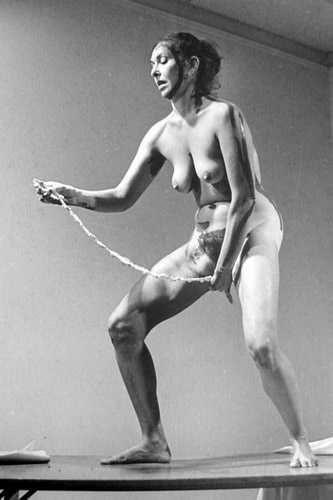
Carolee Schneemann performing Interior Scroll


Certain individuals are mostly interested in what such-and-such looks like (does the brain become "homesick"? - "but homesick for what?" in response), but if there is anything paralleling such cancerous wit, there must be a "corrective punctuation" somewhere (without stultifying the subjectory), without via the William Shatner-like talkative "song" [roar!]; art should only be addressed if personal-need be it debated or discussed (end the censoring, in any case, for the "female condition!").

A few years ago I came across Carolee Schneemann who is essentially "famous for [her . . .] fundamental contribution to the body" of the once controversially-experimental masterpiece (my own opinion) [and highly-poetic impressionism] "Interior Scroll." The eroticism here, could it perhaps be, a visual presumptuousness? One is often forced from Language by its ever-growing repetiveness, and not only this mindful-comeliness, but the "intimidation-factor" that oscillates between individuals whom teach it (or repress it) to others. For "Interior Scroll," there is a "dionysiaque sexuality" here; a "correspondence and fetichisation of (women), in which the concept, the idea, the physical-occurence lies upon a variety of taboos - a "vulvar space" and a "visceral experiment of the flesh." As ART AND FEMINISM states: "Your Body is a Battlefield."


Interior Scroll
Performance, 1975


From site: "Performed in East Hampton, NY and at the Telluride Film Festival, Colorado. Schneemann ritualistically stood naked on a table, painted her body with mud until she slowly exracted a paper scroll from her vagina while reading from it."

Carolee's explanation: "I thought of the vagina in many ways -- physically, conceptually: as a sculptural form, an architectural referent, the sources of sacred knowledge, ecstasy, birth passage, transformation. I saw the vagina as a translucent chamber of which the serpent was an outward model: enlivened by it's passage from the visible to the invisible, a spiraled coil ringed with the shape of desire and generative mysteries, attributes of both female and male sexual power. This source of interior knowledge would be symbolized as the primary index unifying spirit and flesh in Goddess worship."

I think that her work goes beyond just the term "Art." Another piece of hers that really turns me up and down like some botanical garden, is her own personal body-garden known as Eye Body: 36 Transformative Actions.


C. Schneemann's Portrait Partials, 1963

The fuses, the dreamorphologies, the meaty landscapes and experimental monickers of haphazard-beauty ("testing the limits") are all like suave leaves of abstract forests. One of the most powerful (and one of the least known, for the most part) polyartists of all-time. Look into her work and you will see how this woman's work has provided "fuel" for many generations afterwards.


Carolee Schneemann, from More Wrong Things, 2001

2.22.2008

Nina Katchadourian


Self-portrait of the artist as an artist

While I tracked myself across the unviewable landscape of poetsyville, I flooded my senses with attempting to pick more information out of the air in regards to the "Random Poetry" of the delightful Christian Bök. Though the trek was discovered, I found other unexpected backwashes of slippery-bait that struck my interests with an alarmist-jolt to the 'noggin-rut (as flimsy as a hammock).

Meet Nina Katchadourian. From there, her bio: Nina Katchadourian was born in Stanford, California and grew up spending every summer on a small island in the Finnish archipelago, where she still spends part of each year. Her work exists in a wide variety of media including photography, sculpture, video and sound. She is represented by Sara Meltzer gallery in New York and Catharine Clark gallery in San Francisco. Her work has been exhibited domestically and internationally at places such as PS1/MoMA, the Serpentine Gallery, New Langton Arts, Artists Space, SculptureCenter, the Palais de Tokyo, and the San Diego Museum of Contemporary Art. In January 2006 the Turku Art Museum in Turku, Finland featured a solo show of works made in Finland, and in June 2006 the Tang Museum in Saratoga Springs exhibited a 10-year survey of her work and published an accompanying monograph entitled "All Forms of Attraction."

Get this: She dissected Maps. Yes. She dissected road maps for an art-installation piece that absolutely floored me!


Map Dissection I

She explains: "I dissected a AAA road map of the USA, removing all the land and leaving only the connected road network. The map was sandwiched between two large pieces of glass and suspended."


Map Dissection II

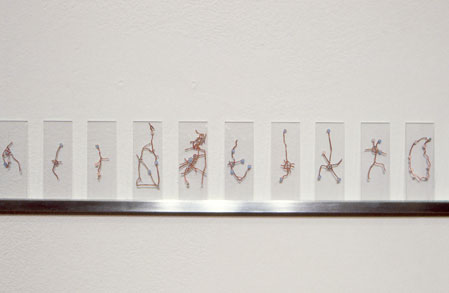
She explains: "A second dissection was made of an identical map, extracting those places were the roads came together to form small knots or clusters and placing them between glass microscope slides. Many of these extractions became quite figurative."


A glass-slide from the Piece

Oh, but there is plenty more from where this brilliance comes from. How about Talking Popcorn?


Talking Popcorn

She explains: "Talking Popcorn is a sound sculpture that evolved out of my interest in language, translation, and Morse Code. A microphone in the cabinet of the popcorn machine picks up sound of popping corn, and a computer hidden in the pedestal runs a custom-written program that translates the popping sounds according to the patterns and dictates of Morse Code. A computer-generated voice provides a simultaneous spoken translation."

She continues (in regards to the "Popcorn Journal"): "The Popcorn Journal is a running record of Talking Popcorn's speech. Each day during the exhibition, a sample of popcorn is placed in a capsule alongside a text output of the machine's complete speech for that day."

Dabbing through the handkerchief of her work is like sneezing and not blowing it. The collection builds and builds, therefore a reinactment is needed to actually sift through the chaotic-beauty, like sifting for Kleenex (er!). The symphonies of this amazing woman's art could never sound better and the fresh pulp is completely (and satisfyingly) refreshing.

From Here: Nina Katchadourian is a conceptual artist, famous for her eclectic projects, some of which involve her mending a spiderweb or sorting a bookshelf. Often her work consists of either a whimsical intervention into a geographic mapping or an uninvited modification of an ecological terrain. She might, for example, dissect a travel map [as previously showcased!], extracting all the landmass, while retaining, intact, all the highways—or she might augment a car alarm, installing a new bullhorn, which screeches out a birdcall instead.

It's worth a visit. The wide-range of work includes mediums such as Video, Sound, Photography, Paper, Sculpture/Mixed Media and Public projects.

1.27.2008

Killer of Sheep (1977)


Killer of Sheep

I first heard about Killer of Sheep when Turner Classic Movies were previewing it for what was to become a festival of Charles Burnett films that were to be shown in the following days. Everytime I am subjected to something as fresh as a new film director, I am always interested in viewing the films that will be showcased. On January 21st (Martin Luther King Jr. Day) TCM had Burnett on as a guest and host Robert Osborne interviewed him before the movie was presented (the world broadcast premiere!). What I found interesting is that this film wasn't supposed to be as famous as it were to become. Burnett made the film as essentially a "project" for the school that he was attending at the time. When the film was completed it was unable to be released because the filmmakers "had no secured rights to the music used in the film," however (after all of this time) late last year "the rights were purchased in 2007 at a cost of $150,000." Soon following the film was "restored and transferred from a 16mm to a 35mm print."

The film is about African-American culture in the 1970s. The plot, as stated from Wiki: Movie critic Dana Stevens describes the film plot as "a collection of brief vignettes which are so loosely connected that it feels at times like you're watching a non-narrative film. There are no acts, plot arcs or character development, as conventionally defined.

Stan (Henry Gayle Sanders) works long hours at his job in a slaughterhouse in Watts, Los Angeles. The monotonous slaughter affects his home life with his unnamed wife (Kaycee Moore) and two children, Stan Jr. and Angela (Jack Drummond and Burnett’s niece, Angela).

Through a series of episodic events—some friends try to involve Stan in a criminal plot, a white woman propositions Stan in a store, Stan and his friend Bracy (Charles Bracy) attempt to buy a car engine—a mosaic of an austere working-class life emerges in which Stan feels unable to affect the course of his life.


Scene from Killer of Sheep (One of my favorites!)

I knew from the very opening scene of the film that I was in for a real treat. After viewing the film for the first few minutes I was immediately reminded of John Cassavetes-cinema, especially his neorealistic film Faces (which was shot in Cinéma-vérité style of film-making). Before I had any knowledge that this film was compared to Cassavetes I wasn't particularly stunned to find out that Burnett had been mentioned in the same light. Cassavetes, as is it well documented, was once a part of Hollywood where he directed two films and also acted in various features. He essentially became annoyed and frustrated with Hollywood so he quit and started making his own films independently (which really catapulted him as a great film-maker). Faces was a film that was completely unconventional and about as Non-Hollywood as one could imagine (which was apparently his intention). Killer of Sheep is shot in the same style: Documentary-like, Unconventional with peculiar compositions and off-the-wall lingo.

The film is piercing and moving. The Bluesy soundtrack really added an extra-boost towards my interest. Killer of Sheep is one of the best films I have seen in quite a long time, and after a "limited release" and random showings in various theaters across the nation, leave it up to TCM to make certain that America is able to see such stunning films in their restored quality, not to mention the interest that they have with showing "world premieres." A DVD of the film has been released which also includes other films by Burnett, including several shorts (which were also shown on the same night on TCM).

Killer of Sheep was chosen by the National Society of Films Critics as "one of the 100 Essential Films," and in 1990 the film "was selected for preservation in the United States National Film Registry by the Library of Congress for being 'culturally, historically, or aeshetically significant.'"

Also, as has been documented, "the film appeared on several critics' top ten lists of best films of 2007." The list includes #2 from The Arkansas Democrat-Gazette; #3 in Premiere; #3 from The Baltimore Sun; #3 from TIME Magazine; #5 from Slate and #10 from LA Weekly. Quite an honor, I feel, for a film that has been basically lying arcane for 30 years!

A must-see film!


Another beautiful scene from Killer of Sheep

1.26.2008

Dead?


Fly


Millions of Americans share this nagging problem, but many, wrongly, are too embarrassed and humiliated to admit it. We can't cure death yet, but we can make it something other than a dirty word by talking openly about it and not being afraid to look for its symptoms. Be honest: Do any of these Five Warning Signals of Death apply to you?


{1} Your scarlet silk handkerchief was ripped in half by a ninja-knife.
{2} You are freezing cold.
{3} You have loved ones who are fighting over your belongings.
{4} You don't hate Bush anymore.
{5} You haven't washed your dishes in three weeks.


§


Camera On Policeman’s Revolver Snaps Evidence


"ATTACHED to the barrel of a service revolver, a compact motion picture camera enables a policeman to take action pictures of any person at whom the revolver is aimed. The pictures thus obtained can be presented as evidence at court.

The motion picture camera is triangular in shape and is attached under the barrel of the revolver by means of metal clamps. The lens is directly in line with, and under, the revolver muzzle. The camera is set in action by a slight pressure on the revolver trigger, independent of the firing of the weapon. Due to the compact size of the gun camera device, only a small roll of film can be accommodated at one loading."

Torpedoed, like the Lusitania in 1915. Far ahead of their time? Now the cameras are on the dash-board, which somewhat takes the fun out of the "snapping revolver," I think.

12.07.2007

Giuseppe Arcimboldo (The First "True" Surrealist?)


The Great Giuseppe Arcimboldo, Self-portrait


McLuhen once noted: "the need for a ratio and interplay among the senses as the very constitution of rationality." A few years ago I was rummaging through a large collection of books in the far-corner of an Antique shop in a small town, digging through 70+ year old rarities and gems (the years were spread throughout the time-line) that had me soaring into some invisible obstacle (strange to most people) of some supramundane seraphim (and this wasn't "Angels and Antecedents," either! - amorinis and the deity-like feeling of floating amongst such a miraculous spectacle of magnificent book-love; completely swooned over) that my "en route" was about as common as the Titus Andronicus, for the most part. Upon arriving, eyes growing operatic, like a body-song, and I always felt as though I was out picking private plums for my Grandmother (we used to pick raspberries and blueberries together; much love, much love), books in my presence, like something burning within!. . .(Napolean once said that he would cover his Josephine "with a million kisses burning as though beneath the equator."). . .promptly entrained (drained) all of my energy into searching for hours on end (all-the-while wishing [and muttering to myself] how I wish I were "rich enough to purchase these books").


Vertumnus (portrait of Rudolph II), 1591


Some of the books I gathered (a must-need) were the rarities entitled, Horizon: A Magazine of The Arts (but in hard-back book-form!), which, from my knowledge, were at least published throughout the 50s and into the 60s (though I am uncertain of their stopping-point). One of these books [November 1960 * Volume III, Number 2] had an interesting painting that I still haven't "gotten over" that was the very first image one sees when they open the book (before the contents-page); ie: the Frontispiece.


Of course, after aspiring to find out who the painting was by, I came across the small write-up on the following page of the painting, which says the following:


The Trojan Horse, that eternal symbol of deceit, was an innocent-looking
wooden effigy filled with armed and waiting Greeks. When the Milanese painter
Giuseppe Arcimboldo addressed himself to this idea, he carried it a step
further: omitting wood, he composed his horse entirely of the writhing bodies of
soldiers. Its eyes are two dark heads, its mane a row of flaming torches.
Arcimboldo's grotesqueries were much admired by the Hapsburgs, who made him
court painter at Prague from 1562 to 1587. Today he is admired by the
surrealists, who look at him as a precursor.


Summer, 1563

At that time, which seems like so long ago, I had already been studying the surrealists, so my eyes gleamed with joy when I read the final line of the frontispiece-contents, "Today he is admired by the surrealists, who look at him as a precursor." The keyword for me in that sentence is precursor. "Amazing!," I thought to myself, which I said a few times in my mind. For me, it was like the singing-scene when the Queen enters from the play, The Play of Daniel, in which she sings, ". . .with sonorous tones of strings and voices let music now be made." And, oh, my heart was certainly singing!

After researching this amazing Italian painter, I was completely struck by the surrealism of his portrait-work, and then concluding that this fellow was far ahead of his time (which, I imagine I am not the only one whom has concluded such ideas!).
Perhaps the first Surrealist of all-time? Salvador Dali, mind you, was a fan of his work, which should tell you a little something. From Wiki: "Arcimboldo's conventional work, on traditional religious subjects, has fallen into oblivion, but his portraits of human heads made up of vegetables, fruit and tree roots, were greatly admired by his contemporaries and remain a source of fascination today. Art critics are now debating whether these paintings were whimsical or the product of a deranged mind."
Since these events, Arcimboldo has gone on to become one of my favorite painters. I periodically find that I want to paint in similar elegances. Apparently I am not the only one. Check out Jan Švankmajer (a Czech surrealist) who has, himself, influenced such famous names as Tim Burton, Terry Gilliam and The Brothers Quay to name a few.
Other good reads about Arcimboldo here, here and here. (I want those models!)


Flora, 1591