Derrickonia Pineconeus

A handful of crumbs & the increasing of the quantity of a substance or other entity that exists in a volume of space. Or: Notes, Films, Poetics, Rememberances, Murmurs & Sgmt. [derrick.tyson@gmail.com]

6.16.2013

“the pleasures of merely circulating”

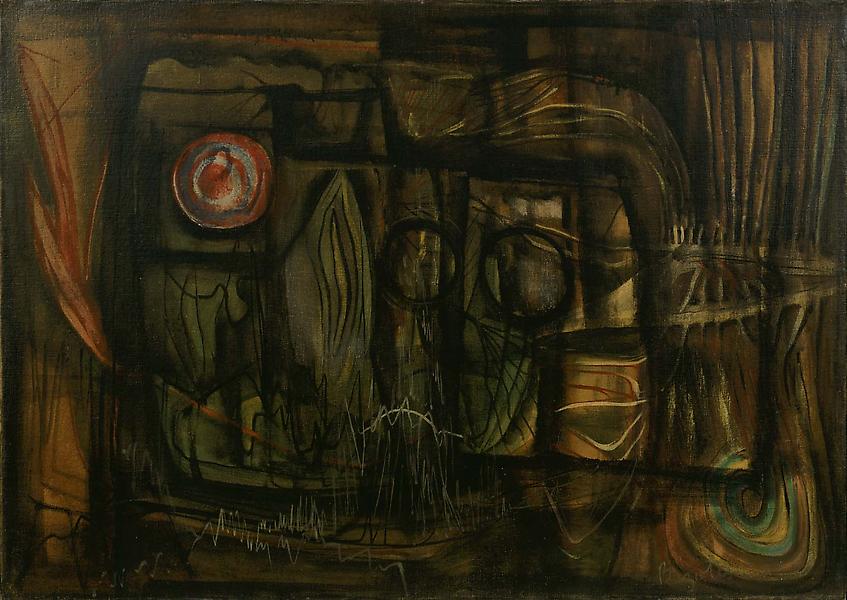
Painting by Michael Olodort


Pierre Bayard: “Our relation to books is a shadowy space haunted by the ghosts of memory, and the real value of books lies in their ability to conjure these spectres.”

Yves Klein: “Nothing exists except in a book, which is the imagination.”

Ghosts, haunting other ghosts?

Speaking of books, texts, ghosts, dreams, I will share some links that I have uprooted from the nest-egg that are worth their weight in gold:

Time, Space and Ghosts of Form: Giorgio de Chiricos Hebdomeros by Ed Sugden

It starts:

What becomes of time and space when an adequate language to describe them does not exist?
Throughout the twentieth century, it has been precisely this question which experimental writers have wrestled with above any other (Alfred Jarry, ‘imagine the perplexity of a man outside of time and space’). Confronted with being on the cusp of history, one step beyond the cresting waves of time, works grappling with the ‘new’ have demonstrated and conceptualised this crisis of identity. Vast spatial blanks, like the terra incognita of maps, have undergirded works from Tristram Shandy to Moby-Dick to The Cantos to The Maximus Poems to House of Leaves. In isolating and describing the impact of the ‘new’ within these works and others like them, it is not sufficient to rely on the common tautological bind which equates and justifies their form precisely by their form, their experimentation by their experimentation (Ezra Pound, ‘to break the pentameter, that was the first heave’). There can only be so much system smashing before the smashed system becomes the system anyway (ad infinitum), and the printed page can only look different so many times. Language in this construction, dangerously, becomes a resource, there to be exploited until hollow, governed by facile laws of primacy and property, a territory to be taken over, regulated and controlled. Attempts to do away with this problem by making belatedness the key condition of art’s ultimate transcendence must be seen to have failed (albeit often gloriously) precisely because they necessarily reconstitute and reaffirm the conditions of their own antitheses, leaving us in a wilderness of broken, crumbling forms, mere rusting arrowheads pointing out from the loam.

I have really gotten into the Ghost Box label in recent days, which has been christened into my brain; in essence, Hauntology. Specifically, bands like The Caretaker, Wretched Excess, The Focus Group, Belbury Poly, etc. This particular link, Hauntologists mine the past for musics future is a beautiful write-up about the genre, and so is this link: Hauntology: A peculiar sonic fiction. From that post, here is a basic definition of this beautiful genre:


The discourse developed around Jacques Derrida’s concept of ‘Hauntology’ and its application to music in the minds of writers like Simon Reynolds, K-Punk and David Toop is one of the most discussed philosophical and aesthetic musical ideas of recent years. Derrida’s original use of the phrase can be linked to a sense of ‘threading the present through the past’, or a ghostly re-imagining of the past defining our existence. But in its musical sense, Hauntology has been used to describe a gathering of disparate artists dealing in “haunted” sonics; music resonating with the emotions and feelings of past analog, and digital ghosts. While there are many interpretations of the concept, we’ve taken it to cover artists who have tried to to re-engage with intangible musical feelings and experiences that have affected their formative years or that have become forever ingrained on their sonic psyche, without merely rehashing them as pastiche. Looking specifically at the British musical landscape of the early 21st century, it’s been said that after the ‘death of rave’ we’re experiencing a sort of creative comedown, where the dubbed ectoplasmic traces of the musical past are caught in an ever-decreasing feedback loop of nostalgia seeping through music and other artistic forms, resonating echoes of intangible elements from days gone by. Our selection veers from The Caretaker's apparitional sample morphology, through Ariel Pink’s exquisite MOR narco-pop, the Ghost Box label’s miniaturised vision of middle England, onto Burial’s mournful rave dreams, all leaving an abstract yet indelible mark on this very particular musical landscape we find ourselves in today.


My recent studies have sent me into those of the voices of post-mortem persons (not really), of foretokened similarities, the undergrowths of birds’ wings, the sounds upon a crap table, keys unlocking doors, door-knobs twisting by unfamiliar hands, or familiar hands in an unfamiliar way, or un-human hands (omnivorous?), a deeper shadow always seems to rest upon the kiosk when one begins delving into the beautifully-bizarre, and my round-the-clock alert (inside of my body, apparently) grabbed me (without a hunch!) and I’ve discovered something that may not be as fulfilling and surprising and interesting as what it may seem, but The Folk-lore and Folk-stories of Wales by Marie Trevelyan, is one that has me right where it wants me. The idea of a “corpse-candle” intrigues me greatly, but also one particular Welsh myth. A vampire myth, at that. One of a vampire chair. Yes, a vampire chair. The story goes something like this (and I’m quoting from another source):


The story says that this chair feeds on blood and whoever sits in it will stand up finding teeth marks on their body. (…) (There was) a chair in an old Glamorganshire house which would “bite” the hands of any clergyman who sat in it, drawing blood. More horrible was the vampire bed in a house in Cardiff. This apparently sucked the life out of a poor little baby. At the body of the dead child was a red mark and the doctor who examined it said: “It was just as though something had caught at the child’s throat and sucked the blood, as one would suck an egg.” The grieving father later slept in the bed and also felt his life ebbing away. He survived but found a similar red mark on his throat. Amazingly, the family did not throw away the bed, but kept it in a spare room! Trevelyan claimed to have seen it there. Old Welsh country furniture is making high prices on the antiques market right now. This well cared for old bed may even now be on display in some emporium, just waiting for an unwitting purchaser...

Moving along now.


            As I was eating in a restaurant on the 13th of June, which was considered my “pre-Birthday dinner,” a 40-something waitress who works at this particular restaurant that has become accustomed by my service over the years, and who also has shed about fifty pounds (in her words), and was on a television show about losing weight not too long ago (also in her words), and who has said to me in the past that she “likes my style,” and has once referred to me as Waldo (because of a particular red-and-whitish-grey sweater that I was wearing one winter, which reminded her of him, and also because I wear vintage, Moscot frames), came behind me and began rubbing my freshly-shaven head, which startled me briefly, but only briefly.
            “Did that freak you out a bit?” she said. “A little bit,” I said, in a concealingly-jokingly way, so of course I only partially meant it, but not to any serious extent, but merely the sudden feel of someone’s hand on a part of your body is always apt to make one's mind shatter into a nervous light of some sort (at least for me, although it sounds far more dramatic than it really is, but nonetheless), so it is what it is. She laughed and seemed apologetic, which made me feel strange, because I didn’t really mean that I was literally ‘freaked out’ by her rubs upon my head, considering, but I decided not to say anything else about it, other than the typical.
            I find it interesting how a random touch, from a random person (that really isn’t so random because you ‘know’ them in that here-I-am-again-it’s-nice-to-see-you-again kind of way) isn’t so bad at all, especially when it’s obviously out of friendliness, as well as out of possible attraction(?). I feel flattered that older women look at me the way that they sometimes do, and this is just speaking out of mere observation, and not out of some egomaniacal way (God forbid!).
            With that said, some peoples’ silences have their own scents. Their own sense. Their own senses. What is it that continuously moves us—that nobody truly minds when they are halfway to the point of realizing that they have found something new and interesting and challenging about themselves—to the extent that we’re beyond “feeling” like emotional messes, when, if only we could become like an octupus where three-fifths of its neurons are not to be found in the brain, but rather in its arms? This is the dawn of some unpopular coinage that may or may not become popular. If it doesn’t become popular, then all’s well. If it does become popular, then show me the money!

*

Observation/Thought:

I wonder if the Headless Horseman was relying mostly on the eyes of his horse? or does the supernatural horror, the mere strength of it, guide him intuitively, like ghosts that are “in the know”? Imagine horror as going into different places, moving in even more unknown “unknown territories”—

*

Whoever you are: some evening take a step
Out of your house, which you know so well.
Enormous space is near; your house lies where it begins,
Whoever you are.
Your eyes find it hard to tear themselves
From the sloping threshold, but with your eyes
Slowly, slowly, lift one black tree
Up, so it stands against the sky: skinny, alone.
With that you have made the world. The world is immense
And like a word that is still growing in the silence.
In the same moment that your will grasps it,
Your eyes, feeling its subtlety, will leave it.

—Rilke

*

Overheard, March 8th, 2013: 

“Do you think I care if I get fired?! If someone hits me, I’m gonna knock ‘em out!” (the young blonde girl who was the listener, in this case, had a smile on her face while her co-worker yelled out the said quote, while random customers were obviously drawn to her loud speech. I spoke to this particular blonde girl in a time past, who I find to be very attractive, but not so personable. The first experience talking with her, I was put off by her nonchalant, uncaring, foul attitude. The second experience was far more pleasant. She must have had a better day. I learned that she has a daughter, to name a few things.) I walked on, while an old woman wearing maroon-colored lipstick who was pushing a shopping cart smiled widely at me as we passed one another.

*

“All fathers are interested in the children they have procreated (they have permitted to exist) in mere confusion or pleasure; it was natural that the magician should fear for the future of that son, created in thought, limb by limb and feature by feature, in a thousand and one secret nights”—“The text mocks the magician’s worries that his son will discover that he is a phantom, as opposed to ‘real’ people among whom the magician includes himself: “He feared his son might . . . discover in some way that his condition was there of a mere image. Not to be a man, (but rather) to be the projection of another man’s dream...”

*

A few days ago, I photographed a waitress bending over into an ice-box to extract scoops of icecream for an elderly man, of which I used the flash (partially to garner attention [which I usually shy away from], and partially because I have to use the flash in darker environments, because of certain mechanical woes with the particular camera that I was using). After the flash went off and a thunderous rumble went through my solar plexus, the waitress (still bent over) looks over at me and says (not necessarily saying it to me, but was looking at me when she said it), “Oh, no he didn’t,” as if saying it to the elderly man. The elderly man smiled and held out his bowl waiting for his scoops of icecream, never acknowledging me, nor acknowledging that he was captured on film.

Naomi Shihab Nye: “The train whistle still wails its ancient sound / but when it goes away, shrinking back / from the walls of the brain / it takes something different with it every time.”

Someone throw me an Eephus...


 Head: Inner and Outerscape (Profile), 1966 by Anton van Dalen


5.26.2013

This Nowhere Where, or; The Fatigue of Wondering & Wanderingness


Achoo, or haiku, to begin: 

Unstirred syrup-spots
Ear-wig stuck in sticky web
Wild wuthering wind

Jung once dreamt that he and a dwarf killed a beautiful blond youth, whom he called Siegfried. It makes me think of Freud’s writings on “language” and “text” in dreams, and how words are often concealed behind different letters, and how they can take on a kind of slant-word/phrase. In Jung’s dream, this “Siegfried” could very well be “Sigmund,” for Sigmund Freud, himself, considering the connections, which leads me to so many different thoughts about Existence, Phenomenology, &c. One thought that arose a few weeks ago is the following:


Am I only “Anywhere” to other people when my voice is heard? Online or real? What is real? Is having a “real voice” no different than being able to see a voice? Reality is no longer designated as being face-to-face, or phone-to-phone. For all anyone knows, I am not real at all, but am only “real” to Me. Am? Am what? Am Me? What is Me? Myself? “My” “Self”? SELF of ME? Vicious vice-versa. It sounds like Twos—double existence: Self[   ]Me, a space in-between. It is like the “double” in Russian Literature, like living a double-life without really living a double-life. TWO. What of this existing “I”? My & Self—Who are you really? You are who? 

Ovid: I shall speak whole silent volumes with one raised eyebrow, / Words will spring from my fingers.

Ovid already had the id in his name, and I bet that gave him a mighty ego.

On one of my favorite Independent Sites, THE AMERICAN THINKER, there was a very interesting article about The Academias, ie., College System, etc., a year or so ago, called The Real Cost of a College Education. One particular element that stood out for me was the idea that free thinking in the System has become pooh-poohed, and of which is looked down upon. From the article: 


. . . Subsidizing degrees in unpractical subjects such as English literature or gender studies results only in more such degrees being issued.  Students then graduate with just as much work-related skills as they had on their first day as freshmen.  Between lectures on the evils of capitalism and on the greatness of Franklin Roosevelt, out-of-the-box thinking is never encouraged. It therefore shouldnt be surprising that Mark Zuckerburg, Bill Gates, and Steve Jobs were all college dropouts.  The fact that their creative thinking wasnt a byproduct of the college industrial complex is a real lesson in itself. The sad truth is that when Congress does what it does best and spends billions passing an extension on the student loan interest rate cap, the establishment will rejoice as the scheme is allowed to continue. But millions of potential visionaries will be the real cost.

Has self-education been dismissed as somehow irrelevant? That would be news to Abraham Lincoln, amongst so many other great men and women in this history of the world. Shakespeare never went to a University, either; I suppose education is essentially about the individuals interest to learn, from a general perspective, rather than just making the rounds. But, in our current age of brain-dead, zombies, television, aspartame, and iPhone-eyebulging, it is no surprise that most of these systems can benefit from such lackluster and dull-numbed muteness. Like Mark Twain once said: Suppose you were an idiot, and suppose you were a member of Congress; but I repeat myself.

*


Leo Tolstoy: Every heart has its own skeletons.


Duane Michals:
How foolish of me to believe that it would be that easy. I had confused the appearances of trees and automobiles and people with reality itself, and believed that a photograph of these appearances to be a photograph of it. It is a melancholy truth that I will never be able to photograph it and can only fail. I am a reflection photographing other reflections within a reflection. To photograph reality is to photograph nothing.

Kertesz:
I am unable to trick myself into soberly examining, with adequate detachment, the shadow that I cast on the reaches beyond me.

Virginia Woolf:
Month by month things are losing their hardness; even my body now lets the light through; my spine is soft like wax near the flame of the candle. I dream; I dream.

*


After Flickr made their all-up-in-your-grill changes lately (Justified, are they?), I find myself a bit ambivalent about it all, partially because I like the changes, and then I do not like the changes, in certain aspects, although it could be a lot worse, but I wont be one of the millions that are complaining consistently about it, so I shall remain MUM, as Gilligan would say. In that light, I plan to stay on Flickr, but I have found an interesting new place that is one of the better art-sharing sites that I have seen in quite a while: artitbe.net, which I have signed up and began posting, which can be found at the following:

http://artitbe.net/works/DerrickT

It is still in its early stages, but I really love the layout and the various options, sleek layout, and easy access to the work, and other artist
s work. 


Derrida: What Comes Before The Question?
My answer:
Usually a sigh and a gulp, or vice-versa...


I found this piece of text that I wrote God-knows-how-long ago, uncertain if I have posted it to this blog before, but in any case, if it has been posted before, there is nothing wrong with a little double-dosing:
I walk into any home and its my spirit that haunts the house as I walk through like a childs first reaction to something enormous, mysterious, colorful. Get behind the circle of the clock. Tonight as I attempted to sleep I heard a vague, but very noticeable in its calling, high-pitched sound that lasted for a few moments, then vanished. The outside world deteriorates and the house stands and laughs, until it, too, is unoccupied, then its flung into the same silent rejoicing. Right now, I am in the dark, but my body is full of light. Over-anxious saliva glands. Throat as sore as an old wooden floor.

Strange to quote my own writing, is it not? Quoting oneself in a slithering second of rawring Reality, would be like speaking with your hand in front of your mouth: the words would become a physical property, bouncing off of the hand, to return directly to the gaping mouth where they were spoken from. Frank OHara once said, beautifully: Now I am quietly waiting for / the catastrophe of my personality / to seem beautiful again, / and interesting, and modern. and this: Im the least difficult of men. All I want is boundless love. I wouldnt state with accurate Absolutes that I worship at the altar of Frank OHaras poetics, because I worship at the altar of no man, and I worship at the altar of no thing, but the signature quality in his writing—the New School of Poetics in the fifties—is an absolute influence that Ive always been quite receptive to (perhaps Im a poet of nostalgia and creepiness?!). I have just recently finished reading THE COLLECTED EARLIER POEMS of William Carlos Williams, as well, and this particular poem I shall share here, which is was immediately engraved into my existence:

I really make very little money.
What of it?
I prefer the grass with the rain on it
the short grass before my headlights
when I am turning the car—
a degenerate trait, no doubt.
It would ruin England.
In the narrow sense, the last line I find quite hilarious, because it seems to be this kind of affirmative demand, as if everyone would certainly understand what he means by it, and certainly this speaks for those underneath the poverty-line, or the difficult times that people can have, but being able to appreciate the small things in life (for the lack of a better phrase), all-the-while, feeling like a free soul, in some sense. To have very little money is one issue, but there is no sympathetic mode of attentiveness there, but this poem makes a dent into my consciousness, because of how beautiful the color green is used without even mentioning the word (money grass), and how, perhaps, warding off any kind of self-pity that may or may not sulk below the surface, is attentive and makes one pay attention! It speaks loud and clear, granting a kind of permanence in the collective psyche of our times. I find this to be one of his stronger suits (the grandeur of ones beautiful romantic streak that may get lost within the obscurity of the esoteric versus the exoteric; what I gather, personally, is beyond the slapstick of contemporary existence, but a true appreciation and love for life, in general). 

Emerson: Give me bareness and poverty, so that I know them as sure signs of the coming muse. . . . The solitude of the body is the populousness of the soul.

Heine:
Out of my own great woe / I make my little songs.

Lord Byron:
My bosom underwent a glorious glow, / And my internal spirit cut a caper.

*

Earlier, the sullen swagger of muggy summer had begun to swarm me, and so did a gnat-swarm, and so I named that particular gnat-swarm, The Great Gnatsby.

*

Here are several interesting links that I feel are worthy to be shared:

Vampires In Ancient Literature

Pictorial Interpretations of Tennysons Lady of Shalott


Book Review: An Hourglass Figure: On Photographer Francesca Woodman, by Ariana Reines

400-plus black-and-white Photographs from the Museum of Contemporary Photography

Top 10 Famous Mummified Bodies

Paintings by Zbylut Grzywacz

Science will destroy humanity, says team of scientists

Essay on The Metaphysical Poets by T.S. Eliot

Finnegans Wake / James Joyce - the full book

*

I have been posting a lot of poems to my LISPY WHISPERS blog in recent times, which can be found HERE

All I smell lately is the sweet aroma of honeysuckles golden elipse on the lips of nature, breathing outward to us, into the air, oh yes, into the air...


4.24.2013

Thoughts on Silence, Ideas, and “a kind of soundlessly spinning ethereal void”


 Wilhelm Freddie, Sensitive Portrait, 1940


Where does one truly “begin”? The ‘act’ and the ‘intent’ of that ‘something’, like a writer, a pen of the past before the “pen” of the future became a technological machine (keyboards aplenty). And perhaps I shall start this off this way:

There are momentous, cosmic instances, where I sincerely yearn to physically be the ink inside of a pen; I want to dive directly into the cosmic chatter, to be the words themselves, to pamper the page with my liquid existence. My notebook looks like the tattoo’d arm of a sailor—pin-ups aplenty, or “pen”-ups, in this case, and my notebook, yes, looks tattooed by a wall of words that move when I turn each page; it’s as if my own words co-mingle with the quotes, so that, somehow, my veins are connected to the veins of the past. To be the ink itself would be like pushing every star in the universe together into super-ball of light (taking up only a small percentage of the universe?)—this is the Writer’s eye, the Poet’s eye of the soul, and the surrounding “dark matter” of what remains outside of this star-charged oneness is like left-over ink, or a kind of inky thumbprint smeared from one end of the spectrum to another, hidden in perhaps the “pen of the future.” Did Bachelard believe that “all corners are haunted” in outer-space, as well?

I should never ‘digress’, but continue to progress. (As Fenollosa would reverb: “No full sentence really completes a thought.”)—there are times when it seems as if my speech and photographs are merging. What Phenomenon is this? Who is to say otherwise to spoil the party? If one looks closely enough, one will discover that people appear, disappear and reappear in photographs. (Naomi Nye once said that she “inherited the ability / to stand in a field and stare,” which she learned from her father. There is a silence that speaks like a clear sky, or as Edmond Jabès would say: “Dreaming is above us, silence below, in stones.”).

I often enjoy placing coffee cups on top of my opened journals (tattooed inkiness, how I’m swathed and cotton-swabbed into this dye’d reminder) in the hopes, oddly or not, that a “bump” or some hullabaloo causes a “happy accident”—ex., perhaps a cat-scattering movement, in the sense that I’d like to see coffee spill onto the pages, even if a drop or two, creating a spot to cover a word, a sentence, or a phrase, a quote, etc., to cover it like Time covers history in its permanent veil, an irremovable, impenetrable, infinite Iron Curtain. To be able to “sniff” a word, as if it were already aromatic, and remember a memory even sharper, like scents that make us Recall, like recollections of a childhood bee-sting—the smell of coffee on texts is like the text that grows like hair on one’s body. S. handed me a coffee bean for me to smell of (“smell of this greatness!”) and so I took it, smelled of it, sniffed and sniffed until I was momentarily out of breath, and then she said, “Now, eat it.” And I did. I ate that coffee bean and the granules were in my mouth, scattering like marbles, kicked my clumsy children on a hop-scotching sidewalk, chalked and powdered—the granules, stuck inside of my mouth, in-between my teeth, and it must have appeared as though I had eaten soil, pure soil, pure black soil from the underworld, and eating coffee beans, or any beans for that matter (“cool beans”), is as close to eating soil as anything.

What is Silence? Who said this?: “The sedge has wither’d from the lake, / And no birds sing.” How odd, no? Are my photographs “eccentric” to some people? The first reaction is key—(Howard Nemerov once said: “Strangeness is a quality belonging inseparably to language and vision.” Aristotle said: “poetic language must appear strange and wonderful” . . . Okay, how about this?: I am so spiritual that even my prayers have prayers. . . .

Photography is my way of writing the Infinite into a frame; and how about a text from Nabokov’s “King, Queen, Knave”?: “Weaving his way among the ramparts of sand that surrounded each bather’s ephemeral domain, hurrying to nowhere in order to prove by a great show of haste how much his merchandise was in demand, an itinerant photographer, ignored by the lazy crowd, walked with his camera, yelling into the wind: “The divinely favored, der gottbegnadete artist is coming!”)

Elias Canetti: “Not to speak anymore, / to place words next to one another mutely / and watch them.”

Elias Canetti: “All the things one has forgotten scream for help in dreams.”

Silence. I hear you. Poets listen to things that most people would consider “voiceless” or inaudible. Even the words speak audibly without a voice to read them. Clark Coolidge’s early statement of “intent”:

“As Stein has most clearly & accurately indicated, Words have a universe of qualities other than those of descriptive relation: Hardness, Density, Sound-Shape, Vector-Force, & Degrees of Transparency / Opacity. I am attempting to peer through the lines into this possible WordArt Landscape, work within it & return with Wordscapes, WordObjects to light & refresh the mind so currently overloaded with centuries of medial Language-Tape.”

Listen to the waves clashing inside of you. Listen as the unspeakable object, whitish and hazy, speaks, as if teasing those that wait for a sound to enter their ears.

If one cannot hear with their heart, they are forever deaf.

Even the wasp will sting without hearing a sound. Silence stings only if you cannot hear a voice within the muted quietude. All “listening” first begins with silence. Let us sit here, together, whomever you are, our hearts singing as One, in the silence of our precious music.

e.e. cummings: “Clouds over / me are like bridegrooms // Naked and luminous”

Rumi: “The puppet show looks charming / but go behind the curtain and see who runs it”

Frank O’Hara said that he would “put up with anything if the orchestra’s big enough,” and I would put up with anything if the orchestra is silent enough, which is louder than most things (within the heart), and also: “what I cannot remember / I see them with your eyes”—Erasmus: “In the land of the blind, the one-eyed man is king.”—I’ve been thinking of the idea of the Pre-Me. I think of photographic ideas and experiments that would correlate to this on-rushing connection! “God knew us before we were in the womb.” Also, “Guardian Angel” series: who truly understands the heart of a poet? I have realized a long time ago that I am not really a verbal person, but rather a visual person. Being able to communicate visually is truly like a gift from the divine.

Frida Kahlo: “I am so often alone . . . I am the subject I know best.”

Art will always be an essential part of human identity. Joseph Conrad once said: “Art is above all, in the first place, to make you see, and the writer’s object is to render the highest of justice to the visible world. Language is a special extension of the power of seeing, inasmuch as it can make visible not only the already visible world; but through it the invisible world of relations and affinities.”

Overheard recently: “Everything your eyeball sees, your eyeball wants.”

What about the other eyeball?

Another thought collapses on me, like a tumbling building, demolished by nature, or by man’s arrogance. Thomas Hardy’s broken heart must cover me like a veil; I understand what one must have felt, like Eliot, or Shelley. This thought, right now, came to me, briefly:

With your eyes, I could see myself clearly in a shattered mirror. My longing, my lips that have missed a kiss for so long, are covered by my hand, waiting for the right one to remove it from my mouth, one finger at a time, in slow-motion?, one breath at a time, in “self-repeating infinities.”

Last night: A spider falls in the dust behind my head-board; what will I dream of tonight? My head, spins, dreams of a hope, when hope was hip, but now is a hip-flexor. Where is that spider? I hope that my mouth stays shut during sleep. The doorknob just appeared like a head poking in to glare at me. I’m awake on the inside; my eyes are like a summer dusk. I went to switch off the lamp, before placing my head upon this harmonious pillow, and I was grabbed, as if the light bulb feels bipolar, and is “taking it out” on me. Then, it said to me!:

When morning rays of light kisses your eyelids, the sun will peek into your heart and capture more of your light to give to the day.

How could I, or anyone, believe this is real? My Imagination is far more “alive” and “real” than Reality. That of which seems “dull,” or “useless” and “lackluster,” comes to life! And I applaud, as a woman and a man watch me from a park bench (yesterday), as I spoke to bright, red tulips—they must’ve thought the flowers didn’t speak back to me in joyous enchanting songs, but this couple could’ve heard it loud and clear had they allowed the orchestras of their hearts to open wide as the mouth of the universe.

*

The other day, as I frequented a café, a woman spoke to me so crisply (as if to “impress”?—surely not!) that I thought that I was turning the pages of a new book, listening to the world spin, torn from normal input, and I was beside myself, then—Myself beside the unexplored “I”. It wasn’t long, after she invited me out to a yoga class (gulp!) that she walked away with a smile upon her complexion, as if I had entered her garden with the only available water remaining upon the Earth.

Truth is this: The ‘dew’ in my soul never lifts; every droplet reflects the enchantments that I’ve felt, that I’ve experienced, and every moment is like a stirred-up sea within me, and the moonlight-tide ceases to exist in a world where I move about like angels in their miraculous habitats (that exists far beyond Time’s tumbling roads). I must be like a vanished bird, still seeking a tree. No bird, nor any animal, ever truly “dies”—they all live on within me! like a procession, like some glass vase full of freshly-picked flowers that never die (in the photograph). My church is my body. I haven’t been kissed by a soft collision of lighted lips in years. . . . I, O, you.

Yesterday, as I documented upon one of my self-portraits, I said that a butterfly flew by me, and took my spirit with it.

This, like the Evidence of A Disappearance, besides not seeing anything. . . .

Do I disappear and loop, hanging from the day-sky? I see a butterfly at night, still fluttering. It’s held on to my spirit for so long that it needs never to slow down. It only pauses to feel the pulse of my love, like a shadow of some cosmic pulse that reveals the beginning of a Vanishing Point. I once said that the eyes of a mirror never close. This is true! There is a kind of offset of feeling of conclusions, born out of near weightlessness, like that of a ruby-throated hummingbird hanging on to one’s wrist.

What of The Naked Eye? Take that literally. Make a photograph out of it, or a collage, or anything. Yoko Ono would say make it into nothing, then bury it.

The Naked Eye, clothing my body? The Naked Eye leaving my body behind?

Perhaps it must’ve been something I ate, or like spies with big eyes eating pies? I just had a bright idea, but now I’m getting a bit “light”-headed. I overheard: “got lemonade that’ll make you see double, and I don’t mean eating the yellow snow” (must’ve been zapping Zappa!). I see some people’s faces, and it’s as if they had been locked inside of a toilet for a few days; people are depressed, not always because of loneliness; it’s sad, but to some people, there are no negotiations, like having “discomfort in the pants.” “Everything strikes me as peculiar”—fascinated by things, all things, and perhaps now I’m merely going in circles; it’s like a wrecking ball that never stops wrecking.

What did the kitchen maid see through the keyhole?

I just realized that, etymologically speaking, my full name when put together could very well mean: a hoist/crane in a contemporary 17th c. theater, perhaps in the “Low Countries” of hæð, or a tract of wasteland, yet abound with high-spirited qualities, which is accurate. Or, if visually: A theater hoist lying peacefully in a heiðr “field,” alone, yet high-spirited.

Seeing an insect so tiny, so minuscule, that it’s nearly invisible. Looks light the ‘period’ at the end of a sentence that just decided to walk off. It is times like this when I need a microscope. If this thing were any smaller, the Naked Eye might have to cover itself up. I extracted a tiny mirror from the ground; a reflection still cast unseen, or by the very remote grounded insects it was viewed, and how shocking to be an ant, a minuscule creature, viewing oneself in so large a structure, an architecture of remembrance, of both present and past, to stop and pause; to be the glow underneath the grounds of the unseen earth.

Decipher me while devouring me. It is necessary to recognize a smallness of the face on a colossal scale.

The greenest foliage of the luxuriance of the forest, intense light pulls the trees into it without mercy. The Light reveals its secrets, like an old riddle, if one turns to it, to consume and accept it.

Collapsing ear drums and a red newborn-baby face in this pre-Summer heat.

Spam-mail, again, hum-drumming along, from Irishka Ross, saying, “I want to establish familiarity with u. Answer me promptly.” The oddness of the person sending “spam” mail; or, robotically-driven? Another one, in my spambox, from “Natashechka,” saying, “I am Sara. Do you like ski? Compose a few words.” 21st century technological non-Whitmanesqueries.

What really happened: I ventured through a spur in the forest, casually at my own pace, a distant call rang in my ears, and suddenly, I fell into an underbush, the twigs all turning into lighted rings!

*

There are certain things that rips me a new skeleton, or rips the skeleton out of me.

Desiderata: “Avoid loud and aggressive persons; they are vexatious to the spirit...”

Jack Spicer “rebuking” Robert Duncan, the poet: “He is too concerned with affirmation, with flying his soul like a kite. . . . He substitutes wit for nonsense, the transcendent for the vicious. It is as if Gertrude Stein and Ralph Waldo Emerson had gone to bed together with Jean Cocteau holding the vaseline.” (!)

Susan Sontag: “Do stuff. Be clenched, curious. Not waiting for inspiration’s shove or society’s kiss on your forehead. Pay attention. It’s all about paying attention. Attention is vitality. It connects you with others. It makes you eager. Stay eager.”


New Poem, by yours truly:


ABSOLUTE COMPLAINT

The only absolute complaint that I could ever have
would be to find myself not gazing
into the mirrorless pupils of Omnipresence,

where eventually I would find my soul
melting outward from my out-stretched body,
pulled slowly out of me like a sun-soaked veil

held up in front of a spectre, or an amused muse--
light, baking me into a “phenomenal smear,”
like a silver-scaled fish on a tattered hook

snatched upward from a pool of crystallization
into the unbreathable air. Perhaps I gasp
beyond the gasping. Perhaps I always will.

*


My body, in-tune, is spread out to sleep, yet never do “I” slumber. Opulent opal memories, some of them full of thorough thorns, prickly remembrances, loud as clumsily-blown trumpeted ballyhoo, and these unexpected exiles I can speak without speech, yet speaking it all to you. Easily amused and easily satisfied, I am. Satisfaction is never the ‘end’ of anything. Seldom does misery create pleasurable experiences, yet when misery roots, it’s bound to eventually wither, and what sprouts from it is an enchanting new beginning. Every day is like a new beginning, or just a continuation of honey seeping from passing day to passing day, seeping perhaps from a jar, slowly, but surely; the taste remains in the mouth until, bong-bong-bong!; an interruption! Interruptions are often necessary as well, for the continuum of poetic maneuvering. Distractions occur and in a flash a new thought arises. Maybe these interruptions are needed for new creations...

*


Borges: “Under the Moon / an extended, solitary / shadow.”

Helen Mort: “Watch how the leaves balance the sky, / then let it fall.”

*

Something about a heart that has been broken from its tenseness, from its elasticity, is a rigorous labor that, at first, seems to wear more and more upon the psyche’, but returns to the source—the mind at this time revisualizes every beautiful thing, flat-lines the Finality of a loss, into a sound that travels through the Body at the speed of light, or faster—inflexions felt further along in the solar plexus, maneuvers without susceptibility, maniacally crashing, like a thousand meteors to the soul, or more, becoming the serpent’s fangs at the point, entering quickly; shockwaves roaring like a volcanic-force before the force can be seen; the entire soul buckling under the fever of all that one has to die to, so that scars cover one like umbrellas; a shell, like its own lingo, its own hibernation.

I shall never dare to abandon the idea that somewhere, somehow, a great love will discover me, perhaps in a gutter, rain pouring, like in Shock Corridor, just as someday the world will be forever without pangs and curses, without a battling nudge of plucking, of worry-warting us all to a swell; the ferocity of an inevitable chasm that demystifies, plunges a loving heart into hysteria, into despair, and perhaps eventual madness—yes, a world with perpetual, endless peace. I somehow become further poetically-enhanced when I feel a connection to something miraculously glorious, that it also has a way of assaulting the “ticklish” part of my existence, like seeing a ventriloquist’s cheeks vibrating with puffs of miniature air-swells.

In reality, my hopes are often shattered, as if the dream itself were made of glass, as if all of my wishfulness, hopefulness, longings, were scattered on the back of a bird with broken wings. Immovable. I often wonder what do other people expect, other than the “normal” expectations? Even though I’m swarmed with an energy that is sopped with luminous variations, often times I feel that if I had to explain in greater detail, in this mad rush of a thought, I’d rapidly have to play possum with Myself so as not to remember my own face in a mirror, so that the light that travels to the visual source is interrupted, to be far more inconsistent than I already am, to vanish before being gazed upon.

W. S. Merwin: “Your absence has gone through me / Like thread through a needle. / Everything I do is stitched with its color.”

Bukowski: “if I never see you again / I will always carry you / inside / outside / on my fingertips / and at brain edges // and in centers / centers / of what I am of / what remains.”

Renoir: “The pain passes, but the beauty remains.”

*

I always feel like every photograph I make is like a film still, always leading to something else . . .

Some things are so beautiful that their presence alone could make me disappear from the face of the globe. One look, and slowly the invisible metamorphosis begins. Another look and I’m blinking out of view. One final look, and I’m the real Invisible Man.

This quote by Clarence John Laughlin sums up the “why” question for me personally:


I am trying to create purely visual poetry, and to use objects as symbols of states of mind.” “He called his early results ‘visual poems’ and meant for the images to be explicated like poetry. For Laughlin, objects possessed an intricate web of psychological associations and a multitude of meanings.


Also:


There have been only two chief and consistent concerns in my work: 1) luminosity — the magic of light itself; 2) the use of the object as a symbol, and hence, of the camera as a living instrument to probe the intangible psychological jungle in which every object is enmeshed.


Susan Sontag: “All photographs are memento mori. To take a photograph is to participate in another person’s (or thing’s) mortality, vulnerability, mutability. Precisely by slicing out this moment and freezing it, all photographs testify to time’s relentless melt.”


George Saunders: “An empty rocking chair rocks faster than any mortal granny could.”

And: “Out the wide window across the room, it’s a crescent moon in bough-crook kind of thing; caramel lights through sectioned panes in houses of white wood, trees blown and slanting like smoke. Windows and doors of the houses wide open with Trust. Children breathe pillow air. Hills roll away behind the row of houses in a fairly pastoral manner. It is a kind of smooth blue Ireland. And the blue is in the room too. It is the blue of night scenes in animation. The cloak of night and all that. It is very much like the nights when little kids point at the moon and say odd things...”


Inside the heart is a heart that beats to the drum of the conscience’s daily waking thought-process. At night, that same drum must be slightly atilt.

I’m at the ticket-window of a new dream, except not being able to sleep gums it all up.

Dorothy really thought that the Wizard was a clear-cut hierarchy of ill communication or a mere spin-off of Jan Van Eyck with eyes that flame brightly, the way that “poppies send up their orange flares.”


A Thought:

Sleeping “soundly”? Shouldn’t it instead be “sleeping silently”? Sleeping “soundly” makes me think of someone snoring, not sleeping peacefully. 


I dream of vocabularies that are loudly inexpressible,
like putting your ear up to a word as if it had decibels.


 Félix Labisse, The Passage Wall, 1951


3.09.2013

Scenarios, and New Photographs (film) that I share out of Partial Shyness, and so on:

Are you warm? said the winter ground to the hibernating animals. No answer. No sound, except those of the crisp rustling leaves.

That is a good way to begin this Share-a-thon, which is really something quite new for me (on this blog, anyhow). Newness provides different complexions. Photography helps me to work on my complexion.

The “un fantasma” (“a mere image”) or that Unrelenting Melt (Sontag).


Self, like unseen dew drops mocking the naked eye.

This makes me think of the idea of the “verbal tunnel”—or, as Hamlet would reverb: “I could be bounded in a nutshell, and count myself a king of infinite space” 


Self-portrait, as if a multitude of oneself could flower beyond the impenetrable lens.

Before taking this, there was a young couple walking hand-in-hand that looked at me briefly with a smile. After taking this, that same couple walked back by as I watched them expecting them to look at me again, but they did not; they just kept walking. Perhaps they saw what the lens would see before I saw what the results were; a kind of  Borgesian Infinity and infinite divisibility.
  
“You can't depend on your eyes when your imagination is out of focus.” (Mark Twain) 


Self, as a shadow of things that once were: The color of Spring-teasing nature makes me feel closer to the very roots of the Phenomenon. 


Rilke: “These trees are magnificent, but even more magnificent is the sublime and moving space between them, as though with their growth it too increased.”
  

Walking Upon an Aftermath, I find: two white feathers (still able to float upon the Life of wind), intestines, a stomach, dried blood, animal fur (that still shivered in the wind).


 Self-portrait amidst clouds reflecting off of a stranger’s window on a cold winter afternoon.


Is that really Me in the Mirror, or Light fractured to appear like Me? My hand seems to want to reach out and repair these beautiful malfunctions; the blow-dryer turned upward; the broken soap dispenser, and the running water that someone left on that I turned off right before taking this image.

“perception is a slingshot drawn back to first plasm...” 

“A jamboree of the senses jarring us into naming our own circus, perimeters...” 

“The human eye, a sphere of waters and tissue, absorbs an energy that has come ninety-three million miles from another sphere, the sun. The eye may be said to be the sun in another form.” (Ronald Johnson)


What rises inside of me is the beginning of a boundary-free connection that only the Cosmos “knows”—

Sometimes the greatest Euphony is to swallow one’s tongue. 

My soul is outgrowing my body; I keep extending by dreaming, like a universe without the law of entropy.


Blog Archive