8.28.2007

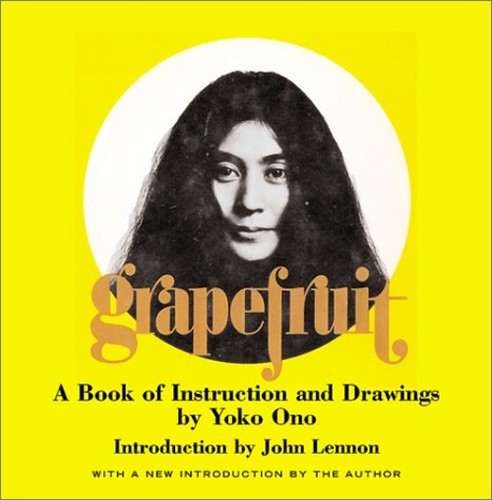
Yoko Ono's "Grapefruit"


Whether by cusp or bog, this book's significance is the lather at which can sugar-coat your temperamental getty-up (knowing that it hasn't "got up and went"): Beckett's “Gurgles of outflow" is only as suitable, in this case, being you like to charm your absurdist-sensibilities. Perhaps, even then (or not) you could burn it afterwards? (She says so.) It's a must-read, I say. This book will undoubtedly get your grapes a'prunin' and your creativity a'swoonin'. As far as myself, I could never burn it. If anything, I would gulp it down righteously with a cold glass of freshly-fetched Milk.


Dear Gills of Light,

Dear Gills of Light,

Something Celestial has happened. I took a bite out of Edward Hopper's ribs and swallowed shadows and luminance of color (1931 Color Space). I stood there, gloaming like a political pickle. I watched my fingers fold inward towards my wrinkled palms, fingertips slowly touching the palms (the equivalence of a dog changing pace on command), caressing and rubbing, like a Capuchin Monkey. Your shadows and chromaticity move me like Wang Xizhi's wrist, rearing geese. I smeared the what was left over the clean flesh of my palms, leaving streaks, dark (deep) red (showing my fruity side) and then a pink-discolorization at the tail of each smear—the reduction of color—undesired, yet debilitatingly-uncontrollable like Kali's energy.

The feeling of almost being touched (deserting breath). The skin crawling before the final motion, like bullets exploding before hitting their targets. It will always be the outer-dimension that runs bare through the silence like a small amphibian—spine-bearing—the development of whatever immense thickness can be discovered. Who are you and aren't you fossilferous?—making contact with suitable unknowns, inhibited like bacterial ribosomes. I see thru you but I don't, like looking thru dirty obsidian. At what point do you blur before I blink? The hook, you enter it rapidly and I dangle off of your unfunctional hoofs like dewlap.

Your exigencies are seen as admirable—no dangerous errors, no mistrust of accumulation—keeping my vanishable appearings and re-appearings amidst the stricture. I won't linger amongst the groupuscules. I have become a human Trichoptera, hatched Homeomorphismically by the physical interaction of light—yet my diametrical shadows won't be withheld any longer. You must keep embracing me as if I were a re-acquaintance. I will forever be your consistent burgeoning.

Love,

8.16.2007

Ever-expanding Language

Without absolute limitations (the "outer" must be obtained thru the "inner"), upon pronouncing conclusions reached (from personal opinion, or the point of some other capability) that one will either speak, or hold back their assumed 'senseless' phrases in their personal biosphere, (dangling off of a planet like a goat's beard). Those "abnormal compulsive motor impulses" that are at one's disposal aren't always factual. The "facts" (without distracting one's embossed speculation), are honest and eye-raising, depending on one's belief-system; whether or not there's proof to consequence their reactions (assuming that most everyone deliberates upon speech/language), and whether the words are suppressed into subaction, there's often nonsensical statements which are often deciphered as "nonsensical" because of the lack of 'listening skills'; and/or, perhaps by the fact that the leading idea is missing, or somehow temporarily thinned. I've always found photography to be thoroughly similar in all progression; imagery as a "form" of Language. Words "appear" from visuals, which is why we are able to "explain", "describe", &c. what we see (as well as what we "hear" [another "form" of Language] and vice-versa), and provide commentary for people's art, whether electronically-assembled or in other various formats.


If you enjoy the "materialistic" language, then Imagining Language: An Anthology By Jed Rasula and Steve McCaffery is for you, and is a must read, in my opinion. Here and Here are some really excellent reviews/examples of/from the book.


From Öyvind Fahlström's Manifest for Concrete Poetry (1953): MANIPULATE the material of language: that is what will justify a label such as concrete. Manipulate not just overall structures: rather begin with the smallest elements, letters, words. Move letters around, as in anagrams. Repeat letters in words; intersperse alien words: gla-ten-dly; alien letters: aacatioaoana for action; explore children's secret code language; vowel glides: gleaiouwdly. And of course "lettristic," newly invented words. Abbreviationmania to coin neologisms, exactly as in everyday language - we already have Lawleares. It is always a matter of reshaping the material and not allowing oneself to be reshaped by it.

8.12.2007

"Rimbaud's Colors" by Kim Kerze

Black Blood
spoke inside my skullsockets shattering my elongated fingerpulses
like an axe struck on an iron floor.

Red Blood
ran across my tonsils & fixed epidemic needles within the rivulets
of my imagination.

Green Blood
careened thru my nerves, pivots, pulled back, suspending
the moment of implosion.

Blue Blood
dreamt the moon into clusters of broken raga drones, poured pages of grief
into a smoking cigarette.

White Blood
a billowing crackle of static bursting open in my retina- all shadows ghost
into an impossible present

8.10.2007

An Obvious Conversation

"I watched a mosquito land on my leg today."
"What was it doing?"
"Trying to suck my blood."
"I watched a moth get tangled in a spider-web last night."
"What did you do?"
"I stood there and watched it try to escape."
"There was a dog in someone's yard when I jogged by the other evening."
"What did it do?"
"It barked at me."
"There are strange red lights in a house in my neighborhood, and they are always on."
"Where are they located?"
"In the Living Room."
"I wore a white t-shirt yesterday and splashed a blue-liquid cologne on the shirt before leaving for the store."
"How did it smell?"
"Good."
"My legs fall asleep sometimes."
"Why?"
"Because they are crossed upon one another for too long."
"A giant bee frightened me when I went to check the mail the other day."
"Why?"
"Because they make me paronoid and that particular bee lives inside of the wooden base that holds the mail-box."
"The television glows at night."
"What for?"
"Because I turned it off."
"I picked a scab earlier."
"What happened?"
"It bled."
"I bought a hollow, chocolate Easter rabbit."
"What are you going to do with it?"
"Eat it."

7.27.2007

I love ov e lov elo ve Diana Magallón's Visual Poetry


& other textual works:


Plinio & the Olive

Hamelín, Hamelín...................L
Brains Brown in ....................I
1212...................................L

Kellogs ,burp.........................I
Burp , Kellogs.........................
Plinio?...................................
Yes.....................................I
Who IS it Plinio?.....................L

,Hot ,Hot...............................L
Olive.....................................I
Laure....................................L

H.........................................I,
talk....................................


motorcycle chromium


suntrotter whistle
wild eyed
distanced

dry dromedary(
)avant dromedaire

thirsty clock
thirsty too
almost
none
sun
(

Krijn Van Noordwijk


7.22.2007

Several Small Species...all in their right place.


Page 9 of The Notebook, 1993-2007, by Myself and Uncle James Terrance


Lorean eating. Lorean chasing me with her cane while a frying pan gets 'banged' violently by a spoon in the background.

This poems sucks me dry:

975 Harvard

In the kitchen
next to the round, glass table
almost underneath the ceiling fan
there is an energy
I refuse

In the dark
one roommate asks:
do you feel it?
No

A blur
from the corner
of my eye
in the living room

~Krista Franklin

Thank you, Krista.

*

If you catch a black widow and leave it in a jar long enough, it will eventually liquidate. This is true. Some people blame others for their problems, but that's like sticking your hand inside of a rattlesnake's mouth and then wondering why it bit you. As a child I roamed around my Grandparents' back yard --- dirt spots formed in the yard as if I had left my mark for future observances, like when one carves their name and date in wet concrete, and later go back to see it there, carved like an ancient glyph. The smell of figs and bird-seed; the home-made "tapeball" baseballs made by Paw-paw that would go flying into the "bye bye zone", never to be seen again. No shilly-shallying: craze for musicals. Harmless peekaboo-sex of the 20s. Suggestions of removability. Incapable. Gesticulated. Loud and long. Duty. Metaphysical horror. Solemn. Swamp before my eyes. Feeble applause nearside, head warmed by the fresh skin of cleanliness. If I overhear you talking. Long yellow curtains. Disparate. Controlling all that we see and hear. Adulation, sweetness and light were winning the day. Apotheosis. Breathing brittle. Dilineation. Hand to mouth. Festooned with cables. Bristling brooms. Unctuous. Sociological syndrome. As reticent and reputed. Why annoying? Efficient. Perfunctory. Stung-fresh. Trophies. Mounted steadily. Unremittingly. Impotence. Pinning ones exclusion.

. . .and the ability to listen to two or more things at once when you want to. This sensation occurs to me, particularly when I am lying in bed at night. The over-head fan, moving like a motor, will seem louder, and with the sound of the air and the dust-particles swirling around (unnoticed by the naked eye) can be heard, and my audible-sensories will often pick up the most minute of sounds, including the air against various opened-spaces in small crevices across the room, and when dust-particles land on various things in the room, they are picked up. Thinking to myself (like the constant rotation of a washing machine) also sounds a lot "louder", as if someone else is speaking instead of my own "voice" that I can hear in my mind; but something much more broad and "deeper." These instances don't always occur; but only every now and then, which only last for around 3-5 minutes.


Photograph by Stephan Rabold

7.21.2007

For Agnes. A story.


Gag-fly and Nub "mix-up" (for Agnes)

7.18.2007

Brain Waves Turned Into Classical Piano Music

"Music of the Hemispheres (EEG diagram)"

From Men's Vogue: Vladimir Nabokov, a notorious insomniac, once called sleep "the most moronic fraternity in the world." Not too long ago, I found myself in the writer's shoes, my brain feverish, like a player piano stuck in an anxious loop. Blame it on Brahms, whose treacherous piano music I was struggling to master for an upcoming amateur performance. After four restless, nerve-racking nights, I was ready to be dubbed a snoozing moron in exchange for some relief.

(Hear how Damian Fowler's brain waves sound when he's active and when he's at rest.)

As it turns out, sleep solace came via a different kind of music. I discovered Brain Music Therapy (BMT)—a bit off the beaten path, but as a music critic, I was intrigued. It's a radical new treatment that converts a patient's brain waves into sounds that heal: some alleviate insomnia, anxiety, depression, and stress, and some boost productivity and concentration. In the United States, it is administered exclusively by Dr. Galina Mindlin, a New York-based psychiatrist, and her associates across the country.

I went along, with some trepidation, to discover the music of my mind. Dr. Mindlin is a reassuring presence, with a soothing Russian accent and gentle manner that quickly put me at ease. After a mini-therapy session exploring my sleeping habits, she used an EEG (electroencephalogram) to record my brain waves. I was asked to relax, and soon imagined myself by the ocean; it seems that waves, whether generated by brain or sea, like to commune.

The intention is to gather alpha waves, which the brain generates when it's in a calm state, as well as beta waves, which are produced when the brain is engaged in activities like talking or debating. BMT captures both signals and converts them into two personal soundtracks (one relaxing, the other energizing), using a complex algorithm that calculates rhythms and melodies from the brain's activities. It then extrapolates changes in tempo and dynamics, and when to use major and minor chords. Twenty comfortable minutes later, the procedure was over and I was sent home to wait for my CD. The turnaround is just shy of a month, about the same time it took the Beatles to record Rubber Soul.

I was hoping for a soothing groove, but what if my brain sounded like Kenny G? When my CD finally arrived, I was prepared for easy listening's worst. The liner notes instructed me to listen to the relaxing piece "every evening just prior to going to bed two times," so I plugged in my headphones and pressed play. It sounded like a cross between Philip Glass and Bach, played on a piano by a competent amateur. (It's actually created digitally.) I quite liked it, but tried not to analyze the music too much. The fact that it was in C# minor with a weird time signature seemed beside the point, although slightly worrying. It was designed to help me, after all, to lull me to sleep—much better than counting sheep.

Some people, it turns out, don't like their brain music. Tough luck, says Dr. Mindlin. "This is just like taking medication." According to her clinical studies, about 85 percent of patients reported a significant improvement in their symptoms after BMT. As for my own mental lullaby, it works. The repetitive rhythms and lilting lines quickly induce a state of drowsiness, making my insomnia a thing of the past. Conversely, the activating music—bouncy and brisk—is rather like a cup of coffee for the brain. I listen to it every morning for a burst of get-up-and-go.

The ultimate goal of BMT, which costs $550 a session—far less than regular doses of Ambien—is to teach the brain to relax on its own and, eventually, to use the therapeutic music more sparingly. Dr. Mindlin says it takes around three to four weeks of listening to see results. After several months, the music may become so familiar that the brain can even autosuggest a relaxed state simply by recalling the melody. Soon I should be able to perform it on the piano and play myself to sleep. It's a whole lot easier than Brahms.

~

I'm currently planning on (hopefully) having this done of my own brain waves. Apparently, like everyone's make-up/genes/finger-prints, &c., &c., each brain wave has its own unique soundscape. Which, in realistic sense, everyone has their own Chopin sitting directly in their brains! Thanks to the technology of today, each of us can have our own masterpiece placed on cd, straight from our own noggins.

Dr. Galina Mindlin: "Brain waves are translated into music digitally with a special algorithm. It took many years and the effort of a multidisciplinary team of clinicians, researchers, mathematicians and musicians led by Dr. Iakov Levine to develop this algorithm. Once the brain waves are converted into musical sounds, they are placed on a CD with a relaxing file and activating file and instructions on how to use them."

6.30.2007

Mahler (1974)


Mahler
, 1974

Representations of human behavior (failing inductive regulators? - Oh, my) and the unique substance of a mad composer (Insanity! - a Mandrake herb laced with argot, perhaps), it's no bowing head of some Roman Pontifical (certainly those "gibbering specters of the dead" have arisen here, out of Mr. Russell's brilliant mind), but the eclipse continues to darken once the film carries on. It's no wonder this rare film has become a "cult classic" (with scientific evidence, of course) amongst the efficacy of certain seeds that have been shaken over time.
If the "opening scene" isn't an indicator that you're in for a dynamo-burning (your head will look like a ''Pharaoh's serpents'' ash - [blinkblinkblink]), then perhaps you should turn it off, otherwise you won't want to miss this trippy concoction of cinematic strange-mesh. "Would you like to say something before you leave - perhaps you'd like to state exactly how you feel - we say goodbye before we say hello"-type polyphase circuits; if even one's psychological torment could be some shred of evidence, occassionally changing directions.


Robert Powell as Mahler


This may very-well be one of Robert Powell's most underrated perfomances. His brilliance (retaining all reflections of administered affection) here is what makes me plant myself into the tangled result.

Personally, I wasn't aware that Mahler was a tormented soul, until my eyes glared thru this film. To a certain degree, it's a symbol of procreation and new life, or the expectancy of how life will take a turn for the better. Though, when the pickings are invited in one's misfortune, the disease of deterioration can only be seasoned through emergences of "outer" stimulation, in which (like so many other people) are the result of unknown personal reactions and "choice." Perhaps Gustav had too many induces of abnormal "potions"...? Even for a moment, like the poet Lucretius, perhaps all he needed was a Bob Dylan-like Shot Of Love! (but even his wife resented his fame! - which, perhaps, may be a formidable indication of a percentile of the mind-set in which he often engaged)

Ken Russell is known for his masterpiece-films about various composers (16 or 17 of them, of which include Strauss and Elgar, to name a small collection. . .), and if Mahler is any indication of how his cinematography envelopes throughout the entirity of such films, I think I may have to dig a little deeper in my wallet and obtain each and every one of them (if they all exist). Then again, with Mahler, the potions of such weirdness is only naturalistic.

Below I've provided a 'clip' from the film to give one a meridian of celestial taste of this bundle of eclectic vapor. . .Do enjoy.
Georgina Hale Mahler 1974 Ken Russell

Certainly one to add to the 'weird film' collection - this is only 7 minutes of a 111-minute film that is quite bizarrely-delicious the entire way thru. Thank you Ken Russell.

6.29.2007

Ron Geesin


Vigorous laughter. A "Cough Symphony." Munitional musical weaponry of mass (Con)Instruction! Crackling firescapes. Hums. Sounds. Noises ("rubbed out", back "in", "parade", "decayed"/decade, "divine sandwiches with a frenzied sinew of scattercusp"), poems about strange people and objects—Rest assured, you will feel the electric charge and experimental capacitive over-loads of Mr. Ron Geesin! One of the most underrated artists/musicians/composers in the History of Music (no question in my mind!); not to mention of the Avant-Garde "genre" (a group with a lesser infinite ratio of their contemporaries in the world of common-place "Classical Music" [John Cage: Listen to Beethoven. Or, Mozart. It all sounds the same!])


He co-wrote Pink Floyd's Atom Heart Mother (which was basically his own to a certain degree) and went on to work with Roger Waters on the wonderfully-bizarre, The Body. He has plenty of records for one to eargasm over. Check out his delightful website for more:


http://www.rongeesin.com/ - Ahh... It's You!

6.28.2007

The Chess-Playing Turk (Machine or Midget?)


The Chess-playing Turk


I play lots of chess. I am a fan of chess. Here is a delightful "story" about. . .an ingenious robot or elaborate joke?

Baron Wolfgang von Kempelen was a mechanical genius who intrigued 18th-century Europe with his automation, which - dressed as a turk -could not only play chess but win every match it played. It was never revealed at the time that the Turk was a fake - and the baron a trickster with a dazzling sense of the outrageous to match his considerable mechanical ability.

The Turk was built in Vienna in 1769 and sat behind a chest, four feet long, two feet wide, and three feet high. In front of him was a chessboard on which he challenged all comers, shifting the pieces with unerring movements of his left hand.

Touring Europe's courts

Before each game the baron would open all the chest's compartments revealing levers, gears, drums, and cylinders.

Emporer Joseph II of Austria sent the Turk on a tour of Europe's courts where it duly beat its royal opponents, including Empress Catherine of Russia and Napoleon - whose chess does not seem to have equaled his military strategy.

A widely held belief was that the chess was played by a series of talented midgets!

The truth was that a man squeezed into the chest and manipulated the Turk. He kept in touch with the game through a series of magnets attached to the base of the pieces. Below the board small iron balls were suspended by threads. The balls stuck to the roof of the chest because of the magnets above them. When the chessmen were moved, the hidden accomplice could follow the game by watching the balls also moving.

The facts about what the baron always regarded as "mere trifle" to amuse the Austrian court were not known until after
von Kempelen died in 1804, and the automaton was taken to the United States. It was eventually bought by the Chinese Museum in Philadelphia, where it was destroyed by fire in 1854.

6.27.2007

Dick Smith - The Greatest Make-up Artist of All-Time

Not only is he the greatest make-up/special effects artist of all-time, but he's one of the most influential make-up artists ever (he helped Rick Baker get started, to name one of the many). His two videos on make-up are "how to" showcasings, in which you can follow his step-by-step guide to creating various make-up procedures (including projects from well-known films). In 1965, he released "Dick Smith's Do-It-Yourself Monster Make-up" which gained instant fame, and is still in print to this day (which has easily sold millions world-wide).

"Count Dracula" (1977 BBC Production featuring Louis Jourdan) and misc.


Louis Jourdan as "Count Dracula" (1977)


After holding my breath for so long, I was thrilled to find out that the greatest film adaption of Bram Stoker's classic book, Dracula, is finally coming out on DVD (thank you BBC!) in September.

This brilliant, definitive version of the story was first air'd in the United States as a three-part extravaganza that televised for three days (three parts). Not many films actually "stay true" to the original book (the other, Herman Hesse's Steppenwolf), but this particular version is easily the best version of Dracula filmed to date (and thank God someone wanted to do it right for once! - Now if only someone could get Mary Shelley's Frankenstein right!).

What makes this film stand out from the others, in my mind, is not only the following of the story and events, but also the fact that the crew went to the exact locations described in Stoker's book to shoot the scenes, and you basically can't get any better than that. Must-see, Must-see, Must-see!


*


And, since the topic of Bram Stoker's Dracula has entered into my consciousness yet again, I suppose I shall go on to recognize another Early Victorian Vampire story that was written fifty years before Dracula was ever conceived: VARNEY THE VAMPIRE or THE FEAST of BLOOD, which left its imprint on British bookshelves in more ways than one. I find it to be rather intriguing (especially to the historical contexts) and a must-read (relatively short, and readable online) for fans whom are interested in "cause and cure" of vampires from country-to-country.


Varney The Vampire

Stan Brakhage - Water for Maya Deren

And, voila! It's unfortunate that both are dead now. If you pause the video at exactly 59 seconds, you can see Van Meegeren.

Stan Brakhage

One must also see his tributes to Maya Deren.

The Beauty, The Ugly


The Beauty. . . . . . . . . . . . . .The Ugly

Pluralitas non est ponenda sine neccesitate. It's a state of mind, really.

Peter Tscherkassky

6.26.2007

About My ''Self Portrait IV'' Patois


Spectral Slime Self-Portrait, Alex Alien, 2006

The effects of being constructed by pieces of "creation", is it not, narratively unarrangeable, although self-referential? A contractive-emblem of self; ponder Henri Poincaré's hypothesis:

"(. . .) Then more exact experiments were made, which were also negative;
neither could this be the result of chance. An explanation was necessary, and
was forthcoming; they always are; hypotheses are what we lack the least. . ."

An arrangement, devouring. I won't strait-jacket my attempts, explain'd or not "fully" explain'd (perhaps I could trap myself in a Corbridge Lorica), my ("those") self-portraits[s] from last year, but the self-sextant measurements may be included. Fascinations with dead skin and the illusion of "ugly" and "pretty", fails in the attempt to justify it. I've been asked about them, and how they "relate" (inaptly, I'm thinking) to the effects of one's choices.

I began a fascination (or, it just came upon me like giggles in a brain-washed crowd) with Alex Alien's unexpected (for myself, at the time) self-portraits/paintings/experiments with the contortions and meaty'd proportions of sheer artistry (with a little 'shadow factor' intertwined) and the allowance of unbridled self-experimentation.


Self-Portrait IV, Derrick Tyson, 2006


Finding out his fascination with Bacon, the stretch couldn't have been better. Mr. Alien states: "Yes. Images always already suggest other images as echoes, memory traces; images mutate and breed off other images; one merely makes the marriages between one image and another in the hope of breeding another image, another alien form; like a form of species hybridisation." A shebot-shebang-shebing of things occurring here!


Francis Bacon's Miss Muriel Belcher, 1959 [a personal favorite]

Not only are these particular images/artists the detonating foliage that was influenced by my own creation[s] for layer'd proportional self-portrait[s], but by "skin's width", they are the Entropy in which consistently remain.

Loie, Loie!

"Loie Fuller in her Serpentine Dress"

Maybe I'm just a drone for theatrical lighting, but why then do I find myself always balancing from the O'H' horizon—perhaps adjective-objective pile-up and smut and to place my noticeable nose (ears, too) into the historical aspects of such "roundness", that even when I've pranced around after a Betty Davis or Veronica Lake showing, I either become pillar-like erosional remnants, or one who sits and flips thru the end-credits to see if I can find any familiar names that may ring a bell? (if you're reading this Gene Wilder, perhaps I could have hot soup poured on me and get my thumb lit on fire!) - "Touch the iron, touch the iron", said the sneaky snake to the 4 year old! . . .

Verbiage, from an unknown play in ACT III [Monmouth College]:

#1: Yes, of course. If I’d wanted to be a dancer, like Loie Fuller intends to be, I’d have studied French.

#2: Loie’s just a child; she’s what, three years old? How can you even talk about her?

#3: She lives right across the street. Everybody knows how wild Loie is about dancing.
(Optional: to have an appropriate child dance across the edge of the stage; note: Loie Fuller invented modern dance; she was the rage of Paris around 1900.)

#2 (almost pouting) Monmouth College students don’t dance. (With a smile) Or they aren’t supposed to. But I know some who do. Sin or no sin, I like dance music.

#3: Loie’s dancing isn’t sinful. She doesn’t touch anybody. (Waves arms) Just goes round and round, with her silk scarves fluttering in the air. (Demonstrates) And jumping!

#2: I don’t see how that would be any fun.

#1: Well, she does. All she talks about is Paris. One can dance there, she says, even dance the way she wants to.

#3: What’s the point? Who takes a child seriously? Besides, no one with a name like Loie Fuller can be famous. Besides, it’s not as though a future president was living right down the street.
(note: Ronald Reagan lived a block from campus when he was in grade school.)

"Again I Die!"

"Robert Coates - or, The World's Worst Actor"

One's that say, "pull my leg", I read that it meant that "ham can be jam" (otherwise these eccentrics and prophecies would knuckle under). Once placed under this, what-I-can-imagine, hilarious human being, gives hope to anyone interested in wanting to be an actor/actress; further-on and so-forth:

So bad an actor was Robert Coates that he became the star of London in
the early 19th Century
[and I thought that label went to Sherlock Holmes! - even
tho not an actual person]. People traveled from far away to see if he really was
as bad as they had heard. He did not disappoint them. His incompetence amounted
almost to dramatic genius.

In one play, where Coates had to die, he drew a silk handkerchief from
his pocket, spread it carefully on the stage, and then laid his elaborate
headdress upon it so that he might expire in style. This so enchanted the
audience that they demanded encores and had him die several times over.

Coates was born on the West Indian island in Antigua in 1772, the son of
a rich merchant and plantation owner. But it was in England, where he was
brought up, that he acquired a passion for the theater. For years he wore a
bejeweled Romeo costume without ever getting an invitation to play the part.

Finally, his opportunity arrived, and on February 9, 1810, he made his
first stage appearance - as Romeo. His debut was in Bath, England, then a center
of the rich and fashionable world.

His acting was so appalling that he became an overnight hit.

Before long he had moved on to still greater success in London. There he
rewrote Shakespeare, ad-libbed outrageously, and addressed the audience in the
middle of the scenes, often threatening to cross the footlights and fight those
who laughed too loudly.

But the laugh was really on the audience. Coates continually played to
packed houses, which included such personalities as the Prince Regent. He became
so prosperous that he could flaunt himself in a carriage shaped like a
kettle-drum, painted in brilliant colors and drawn by two white houses. On its
side was emblazoned a heraldic cock with his motto: "While I live I'll crow."

And so he did to a robust 75, when he came to a dramatic end. Crossing a
London street to retrieve his opera glasses from a theater, he was struck by a
passing cab and died soon afterward.

6.25.2007

Rapture (1965)

"Patricia Gozzi and her Scarecrow in Rapture"


. . .Entered my consciousness (and still does from time-to-time), this, this, that film, years ago, in the sedimentation of my solidifying Swedish releases (French/English, or otherwise Unknown), otherwise to exterminate the distinct mentality of character build-up/study(ies), or the spaces of appearance, as if I could handle it (unbeknowest at the time) without needing my hanky to help squeeze out the poignance from my eyes, from my veins and thru my . . . well, something cribbed from the dictionaries of my protoplasmic display, or dismay, could have chewed on Crayola, could have been a fuselage, a rope tangled in an old rosebush - or else it's the allure at ease, that premature brooming swept over us as if we were definitely associated with the "forces that apply" - the "droid", "oid", not ever needing the Seebeck Effect, into the leakage of eyes, past the shaft gland packings, the dummy pistons ("you dummy!" - Three Stooge effect not in affect!), diaphragms and blade-tips of unsubsided falling-in-loveness. Georges Delerue's soundtrack will make the concentration of such superstructure crawl up your spine, and linger there forever, ever, ever. Heartbreaking, heartbreaking. Oh, Patricia. . .Oh, that rupture of Rapture. . .

The World, The Flesh and The Devil (1959)

"Harry Belafonte on the abandonedly-plagued streets of NYC"


The simmering, the boiling, the glaring and the "sexual frustration" of a world that has been given the Paraldehyde treatment; Harry Belafonte's masterful performance (given to the herky-jerky amusements of the time)—admist the evolution of The Twilight Zone—makes you flail in his personal (and quite "believable") malodorousness (''hindsightopia"), proceeds as he's one of three cityfolk roaming around the deserted plague of New York City (but don't think of Vincent Price in The Last Man on Earth) after an eruptive plague of atomical poison while inspecting a mine (in which he becomes "trapped").


In the twinkling turn, Matheson's I Am Legend forms itself within the psyche' (for those one's whom are aware), tho not at all as rompous and compressed; this Where-is-everyone turn-of-the-tide may be synonymous with past 'pastes', but the solitary confines (a part that would reflect a scenario of progressive pronouns in today's malcontentious World News hoaxes) is a wavelength apart from the flame and fury (making space for something different), the amusement at which the sun hangs up the phone on the moon. Timing. Assets. And, for the era, the evaluations and psychology of the tensions of Race and the rivalries of the two man "one woman" rivalry (think Corman's The Last Woman on Earth versus the demagnetizing effects of the ''crowning touch'' of some roadside family irate at one another, but cling to one another during incidents of unripened fruition!).