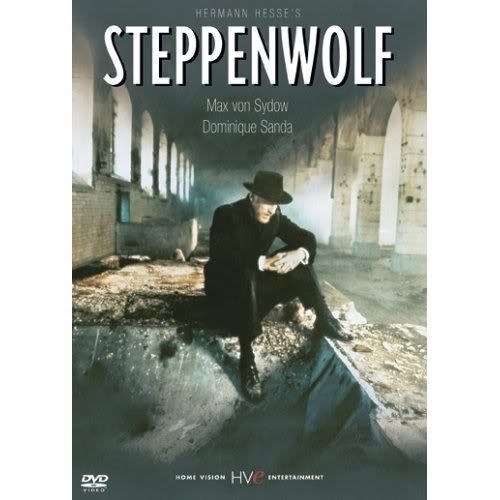
Steppenwolf, starring Max Von Sydow
A handful of crumbs & the increasing of the quantity of a substance or other entity that exists in a volume of space. Or: Notes, Films, Poetics, Rememberances, Murmurs & Sgmt. [derrick.tyson@gmail.com]

This film (starring Max Von Sydow as the Steppenwolf) is in my Top 10. One of the most underrated films of all-time (and the most bizarre, I do say) based on Herman Hesse's great novel.

Every Portrait is always connected with another Portrait:
Here, "Coffee" by Richard Diebenkorn, 1959

Spring-Heeled Jack, Leaping Away
In southwest London, mid 1830's, what was once a "rumor" for the most part had quickly became terrifyingly-confirmed in February of 1838, about the persisting reports of a leaping, bounding superman who was an alarming figure that flew through the air in great leaps across many paths. To most, naturally, it would seem like something out of one's highly-equipped imagination, but apparently this spring-heeled creature was more than that, and became something of a legendary tale.
Jane Alsop was young and pretty. She lived with her two sisters and their father on a London back street. She had heard of the bogeyman called Spring-Heeled Jack, but she was too "sensible" to heed such tales.
One night there was a violent knocking at the door. Jane went to answer it. The man standing in the shadows near the front gate swung around, blaring, "I'm a police officer!" He went on, "For God's sake, bring me a light, for we have caught Spring-Heeled Jack in the lane!" Jane thought about this for a moment: "The stories were true after all." She ran off to fetch a candle. "I'll see him being arrested," she thought, as she rushed back outside with the candle. But, as soon as she gave the man the man the candle at the gate, he grabbed her by the neck and pinned her head under his arm. Then he ripped at her dress and body. She screamed and tore herself away. He chased her, caught her by the hair, and clawed her face and neck. Her sister, hearing the screams, ran into the street and cried out for help. But before anyone could stop him, Jack soared away into the darkness.
Jane later described her inhuman attacker to police officials. "He was wearing a kind of helmet," she had told them, "and a tight-fitting white costume like an oilskin. His face was hideous, his eyes were like balls of fire. His hands had great claws, and he vomited blue and white flames."
This description that Jane had given was repeated over and over again in the following years. Always the leaps, the flames, and the eyes of hell were recounted. Lucy Scales, 18 years old, the sister of a butcher, had just left her brother's house one evening on her way home with her sister. As they walked along a lonely street, a tall, cloaked figure jumped out of the shadows. He spat blue flames at Lucy's face, blinding her.
During the 1850's and 1860's, Spring-Heeled Jack was sighted all over England, particularly in the Midlands. In the 1870's, army authorities set traps after scared "sentries" reported being terrified by a man who darted out of the darkness to slap their faces with an icy hand or sprang onto the roofs of their sentry boxes. Angry townspeople shot at him in the streets one night in 1877, but, as always, he merely laughed and melted away into the darkness.

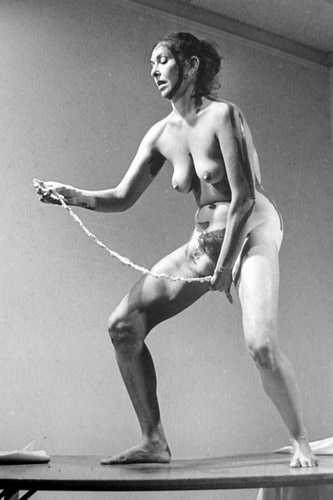
Carolee Schneemann performing Interior Scroll

Interior Scroll Performance, 1975
From site: "Performed in East Hampton, NY and at the Telluride Film Festival, Colorado. Schneemann ritualistically stood naked on a table, painted her body with mud until she slowly exracted a paper scroll from her vagina while reading from it."
Carolee's explanation: "I thought of the vagina in many ways -- physically, conceptually: as a sculptural form, an architectural referent, the sources of sacred knowledge, ecstasy, birth passage, transformation. I saw the vagina as a translucent chamber of which the serpent was an outward model: enlivened by it's passage from the visible to the invisible, a spiraled coil ringed with the shape of desire and generative mysteries, attributes of both female and male sexual power. This source of interior knowledge would be symbolized as the primary index unifying spirit and flesh in Goddess worship."
I think that her work goes beyond just the term "Art." Another piece of hers that really turns me up and down like some botanical garden, is her own personal body-garden known as Eye Body: 36 Transformative Actions.

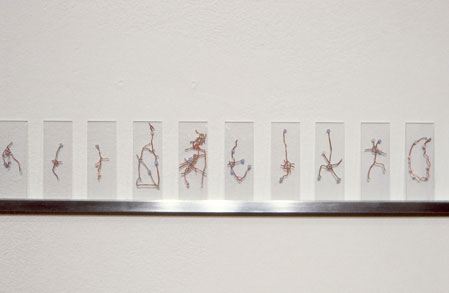
C. Schneemann's Portrait Partials, 1963
The fuses, the dreamorphologies, the meaty landscapes and experimental monickers of haphazard-beauty ("testing the limits") are all like suave leaves of abstract forests. One of the most powerful (and one of the least known, for the most part) polyartists of all-time. Look into her work and you will see how this woman's work has provided "fuel" for many generations afterwards.

Self-portrait of the artist as an artist
She explains: "Talking Popcorn is a sound sculpture that evolved out of my interest in language, translation, and Morse Code. A microphone in the cabinet of the popcorn machine picks up sound of popping corn, and a computer hidden in the pedestal runs a custom-written program that translates the popping sounds according to the patterns and dictates of Morse Code. A computer-generated voice provides a simultaneous spoken translation."
She continues (in regards to the "Popcorn Journal"): "The Popcorn Journal is a running record of Talking Popcorn's speech. Each day during the exhibition, a sample of popcorn is placed in a capsule alongside a text output of the machine's complete speech for that day."
Dabbing through the handkerchief of her work is like sneezing and not blowing it. The collection builds and builds, therefore a reinactment is needed to actually sift through the chaotic-beauty, like sifting for Kleenex (er!). The symphonies of this amazing woman's art could never sound better and the fresh pulp is completely (and satisfyingly) refreshing.
From Here: Nina Katchadourian is a conceptual artist, famous for her eclectic projects, some of which involve her mending a spiderweb or sorting a bookshelf. Often her work consists of either a whimsical intervention into a geographic mapping or an uninvited modification of an ecological terrain. She might, for example, dissect a travel map [as previously showcased!], extracting all the landmass, while retaining, intact, all the highways—or she might augment a car alarm, installing a new bullhorn, which screeches out a birdcall instead.
It's worth a visit. The wide-range of work includes mediums such as Video, Sound, Photography, Paper, Sculpture/Mixed Media and Public projects.
Stan (Henry Gayle Sanders) works long hours at his job in a slaughterhouse in Watts, Los Angeles. The monotonous slaughter affects his home life with his unnamed wife (Kaycee Moore) and two children, Stan Jr. and Angela (Jack Drummond and Burnett’s niece, Angela).
Through a series of episodic events—some friends try to involve Stan in a criminal plot, a white woman propositions Stan in a store, Stan and his friend Bracy (Charles Bracy) attempt to buy a car engine—a mosaic of an austere working-class life emerges in which Stan feels unable to affect the course of his life.

Scene from Killer of Sheep (One of my favorites!)

Camera On Policeman’s Revolver Snaps Evidence
"ATTACHED to the barrel of a service revolver, a compact motion picture camera enables a policeman to take action pictures of any person at whom the revolver is aimed. The pictures thus obtained can be presented as evidence at court.
The motion picture camera is triangular in shape and is attached under the barrel of the revolver by means of metal clamps. The lens is directly in line with, and under, the revolver muzzle. The camera is set in action by a slight pressure on the revolver trigger, independent of the firing of the weapon. Due to the compact size of the gun camera device, only a small roll of film can be accommodated at one loading."
Torpedoed, like the Lusitania in 1915. Far ahead of their time? Now the cameras are on the dash-board, which somewhat takes the fun out of the "snapping revolver," I think.

The Great Giuseppe Arcimboldo, Self-portrait

Vertumnus (portrait of Rudolph II), 1591
The Trojan Horse, that eternal symbol of deceit, was an innocent-looking
wooden effigy filled with armed and waiting Greeks. When the Milanese painter
Giuseppe Arcimboldo addressed himself to this idea, he carried it a step
further: omitting wood, he composed his horse entirely of the writhing bodies of
soldiers. Its eyes are two dark heads, its mane a row of flaming torches.
Arcimboldo's grotesqueries were much admired by the Hapsburgs, who made him
court painter at Prague from 1562 to 1587. Today he is admired by the
surrealists, who look at him as a precursor.
Chris Marker, a French film-maker (and writer and photographer, among the thrips and ranges he possesses) created La Jetée in 1962; a short, 28-minute masterpiece (black and white) that was created using mostly still-images while a narrator fills the viewer in on the going-ons (the "voice-over") of the story. The only non-still image that is in the film is when a woman flutters her eyes to the camera as she wakens from a dream (!!!). La Jetée tells the bizarre story of a "post-nuclear war experiment in time travel"; not to mention, of course, a film about war and memory. Or, perhaps the lack of memory, depending on the science of observation (undifferentiated slaughter of the eyes!).
The story takes place in (or "during") War World III, in Paris, under the crumbling chaos of the city. Van Gogh once said, "I am painting infinity," and somehow this particular film allows me to reflect back on that comment. But in reverse. However, the film, to me, is like disassembling permanence. In all of this, where is the body politic[?], I thought. Anyhow, a man (the man in the image above) is sent back to the past and back to the future to supposedly save all of mankind.
From Wiki: "In the movie, the survivors of a destroyed Paris in the aftermath of World War III live underground in the Palais de Chaillot galleries. They research time travel, hoping to send someone back to before the devastating war to recover food, medicine, or energy for the present, "to summon the past and future to the aid of the present". The traveler is a male prisoner; his vague but obsessive childhood memory of witnessing a woman (Hélène Chatelain) during a violent incident on the boarding platform ("The Jetty") at Orly Airport is used as the key to his journey back in time. He is thrown back to the past again and again. He repeatedly meets and speaks to the woman who was present at the terminal. After his successful passages to the past, the experimenters attempt to send him into the deep future. In a brief meeting with the technologically advanced people of the future, he is given a power unit sufficient to regenerate his own destroyed society. On his return, he is cast aside by his imprisoners to die. Before he can be executed, he is contacted by the people of the future, who offer to help him escape to their time, but he asks to be returned to his childhood. He is returned and finds the violent incident he partially witnessed as a child was his own death as an adult."
The arrangement of the film is stunning, and when I first saw this film (during TCM's Short Film Festival) a couple of years ago (though I had read rviews about it long before realizing TCM was going to be showing it), I found myself questioning my own creativity (!!!) and Imagination (!!!). McLuhan: Imagination is that ratio among the perceptions and faculties which exists when they are not embedded or outered in material technologies. The mayhem in this film is "haunting"; not only with its consolidation thrusted in original-style, but also the film's sheer brilliance in allowing the viewer to be somehow intertwined puzzingly (without being able to actually see the "motion" of each "scene"), like some Apocalyptic-undercutting that could flip shade and shadow into pancakes of light! The mightily measuring-tape was out from my mind as if I had been measured (and, as I imagine, the viewer, as well; all viewers; everyone who has had the opportunity to view this film) by the mere surge at which somehow decontructs our stricture of imagination. Or, perhaps this is my own 'awareness' or Jack-knife!
Interesting to note some of the influences as well (via Wiki): "The scene in which the hero and the woman look at a cut-away trunk of a tree is a reference to Alfred Hitchcock's 1958 film Vertigo, which Marker also references in Sans Soleil." "A famous tiny bar in Tokyo is named La Jetée and is decorated with posters of the movie (I must visit someday!). "The music video for Son of Sam (song) by Elliott Smith (directed by Autumn de Wilde) was inspired by "La Jetée"." Terry Gilliam's 12 Monkeys was also inspired by La Jetée. {to name a few}
In closing, this film must certainly be experienced, if anything for the totality of the diversified field at which is portrayed (running around with Fred Flintstone feet!). On of my all-time favorite films. Top 50, at least.

scene from the eerie, psychological-thriller, Seconds
Once stated: "One of the ultimate psychological thrillers, as if sprung from Kafka, about a man given the ability to start his life over with a new identity and career. Goldsmith’s wonderfully eerie and disquieting work was a key element to this film that looked and sounded like nothing previous." And one must be certain, you won't be the same after seeing this bizarre film (buy it here for an amazingly-low price! A steal!) that featured the underrated Rock Hudson! It's almost like some "agony of passion" that is partnered within this film, and one must un-pop the cork and then chew on it.
The Plot, as following, from the ever-wonderful Wiki: "Arthur Hamilton (played by John Randolph) is a middle-aged man whose life has lost purpose. He is disengaged at his job as a banker, and the love between him and his wife has dwindled. Through a friend whom he thought had died years earlier, Hamilton is approached by a secret organization, known simply as the "Company", which offers wealthy people a second chance at life. The Company, in the person of Mr. Ruby (played by Jeff Corey), interviews Hamilton, and resorts to blackmail to convince Hamilton to sign on, foreshadowing the unfortunate consequences of accepting the Company's assistance."
"The Company makes Hamilton appear to have died, by faking an accident with a corpse disguised as him. Through extensive plastic surgery and psychoanalysis, Hamilton is transformed into Tony Wilson (played by Rock Hudson) As Wilson, he has a new home, a new identity, new friends and a devoted manservant. The details of his new existence suggest that there was once a real Tony Wilson, but what became of him is a mystery."
"The remainder of the film follows Wilson as he copes with the consequences of his new identity. Relocated to a fancy home in Malibu, California, where he works as an already established artist, he commences a relationship with a young woman named Nora Marcus (played by Salome Jens) and for a time he is happy, but soon becomes troubled by the emotional confusion of his new identity, and by the exuberance of renewing his youth. At a dinner party he hosts for his neighbors, he drinks himself into a stupor and begins to babble about his former life as Hamilton. It turns out that his neighbors are "reborns" like himself, sent to keep an eye on his adjusting to his new life. Nora is actually an agent of the Company, and her attentions to Wilson are designed merely to ensure his cooperation."
"In violation of Company policy, Wilson visits his old wife in his new persona, and learns that his marriage failed because he was distracted by the pursuit of career and material possessions, the very things in life that others made him believe were important. He returns to the Company and announces a desire to start again with yet another identity. The Company offers to accommodate him, but asks if he would first provide the names of some past acquaintances who might like to be "reborn."
"While awaiting his reassignment, Wilson encounters Charlie Evans (played by Murray Hamilton), the friend who had originally recruited him into the Company. Evans was also "reborn", and also could not make a go of his new identity. Together, they speculate on the reason for their failure to adjust, attributing it to the fact that they allowed others, including the Company, to make their life choices for them. This realization comes too late, as Hamilton learns that failed reborns are not actually provided new identities, but instead become cadavers used to fake new clients' deaths."
§
In my opinion, John Frankenheimer is one of the most underrated film-directors in the history of cinema, and I truly believe that, for a vast number of reasons. The man who directed such masterpieces as Birdman of Alcatraz, The Manchurian Candidate, Seven Days In May to name a few, doesn't often get the acknowledgements that he naturally deserves. Then again, maybe I am just beating around the bush, and am unaware of it if he has, but to my knowledge, it seems almost faint. Seconds is a must-see. You won't be let-down, believe me...


left to right: Bram Stoker, Henry Irving

Way Out (article from FILMFAX, continued on the site...)
In 1961, this creepy television series (hosted by the great Roald Dahl [he's everywhere it seems, in similar fashion as to how Richard Matheson, credits-galore, can be found on many, many various noteworthy publications, television shows, films, &c., &c.]) followed The Twilight Zone, which to some people, is even more bizarre than Rod Sterling's once unlimited series of the excessively-weird.
However, Way Out unfortunately didn't last as long as Twilight Zone, which was limited to only 14 episodes. What is even more remarkable, to me, is that these episodes are quite obscure, and yet to exist on any DVD-format (not even VHS for that matter!) and people have been ranting and raving for this series to be released for the longest time, but nothing has come about. Thanks to the greatness of YouTube, rarities can be re-discovered (though a DVD-set would be much more fluent, of course), and luckily (or thankfully) a few of the episodes can be seen there. Start here with "The Croaker" and carry on with the others. From that particular video's "About This Video" section on the right, the following is stated: "This rare series has never aired since 1961 and never released on video. Of the 14 episodes, 5 of them (including this one) have been floating around on the net, but the only way to see the other 9 elusive episodes is to pay a visit to The Museum of Television & Radio in NY." Ah, such a shame.
Another great "artifact" about this series was the fact that Dick Smith did all of the make-up works, which is another reason to check them out (and keep all fingers crossed that this series will be rightfully-handled and properly-satiated in the future for a DVD-release!).
Read more about Way Out here and here. The second link has images that can be clicked on for the bigger version (well worth the viewing-pleasure, in my opinion!).
~
In other thoughts; everyone should listen to Lucia Pamela's Into Outer Space With Lucia Pamela. From Deuceofclubs.com, it says: Former Miss St. Louis Lucia Pamela was obsessed with the moon. She wrote songs about the moon. She claimed there were animals on the moon. She even claimed her album was recorded on the moon. They used to say that people obsessed with the moon weren't quite right. (Hence, the word lunatic.) But I think they weren't quite right. Lucia's pretty much out of it these days, which is a damned shame. But her grandson Kenny is carrying on the tradition with Spaceship Kenny.
In fact, she has since gone on to her reward now. She once said: You can't live life going backwards. You must go forward. She lived up to the age of 98. Apparently she thoroughly stood by her positive quote! Find out more about her here. Another interesting site about her here (which has sound, and animation!).
The coolest tree, ever. My absolute favorite tree, ever.
Wiki says: "a leguminous tree or large shrub native to the Antilles, southern Mexico, Central
America and northern South America. It grows to 9 m tall, often much less and very contorted in exposed coastal sites. In other environments it grows into a low dome shape with a clear sub canopy space. leaves are bipinnate, with 5-10 pairs of pinnae, each pinna with 15-25 pairs of leaflets; the individual leaflets are 7 mm long and 2 mm broad. The fruit is a twisted pod 5 cm long. (2nd stanza) The Divi-divi is one of the more well known species of Caesalpinia; it is a symbol of Curaçao and is very popular in Aruba where it is called "watapana". On the islands this tree is never straight because of the wind."

Fernando Pessoa (Poet, 1888-1935)

Rudolf Sponsel, Erlangen's (?) Frankenstein's Logic
(Looks more like a 'breed' of Dracula to me)
One of a few images of (...) "the cycle of Anti-(G.W.F) Hegel pictures..." Hm, I wonder what Mr. Sponsel had against Mr. Hegel? A matter of opinion, I suppose, like everything else. From the source, states: The text on the picture on the pillar on the head Hegel also comes from above, Section 323, Auxiliary, p. 274: The electricity is the purpose of pure form, which is exempt from it, the shape, their indifference Lift begins; Because the electricity is the immediate salience or even from the shape Coming, they still conditional existence, or not yet the dissolution of the shape itself, but the Superficial process, in which the differences the shape leave, but they have to their condition, And not to them as self-employed.
"All clear?" - Uh, not particularly. From Hegel himself ('aesthetics, Volume 1, p. 60): "Because the artwork is not a content in its generality as such, but this individualized general public, in front of the few sensual outlook. If the artwork is not from the principles, but it underlines the general public with the purpose of abstract teachings, then it Bildliche Sensual and the only one external and unnecessary jewelry and artwork in a broken himself, in what form and content of no more than to grow into one another. The sensuous individuals and the mentally General are then each other outwardly."

Heart-breaking scene from Cries and Whispers
Do you want to know the most difficult film for me to watch? Would you like to know of a film that ruptures my tear-sacs into almost phlegmatic-weariness, yet strikes me with the accomplishment of the habitual-emotion of blatant pliancy? Would you like to be informed of a film that is painful for me to view, yet a film that has me yearning for more of the same pain? That almost peculiar feeling of "pleasure" and "pain"; the seemingly realistic frequencies of a film's believabilities, of the human behavior: the power of emotion, the melancholies of sickness and Death; the bizarre submissiveness of Life; "the world of women" that "is very open of (...) gender and sexual politics" at the turn-of-the-century (19th); one of the most moving films I have ever seen? The "erotic mystery" (the "physical decay") of four sisters ("each representing a different aspect of a woman") that embraces you immediately with their presence, traits and idealogies? Ingmar Bergman's Cries and Whispers is this film. Bergman himself explained from the initial script: What it most resembles is a dark flowing stream: faces, movements, voices, gestures, exclamations, light and shade, moods, dreams. Nothing fixed, nothing really tangible other than for the moment, and then only an illusory moment. A dream, a longing, or perhaps an expectation, a fear, in which that to be feared is never put into words. It's really all there. I find every emotion seeping out of me when I watch this film. I find that I somehow become those faces, movements, voices, gestures, exclamations, light and shades and every bit, ounce, degree and shape and folds and formations of those moods and dreams...
Scene from Carnival of Souls (1962)
It's the imagination of originality that ("the day the world gets [more] round?" - God Bless George Harrison!) that gets the loudest ovation and the most hands clapping with an applause. The unaimlessly-multitudinous psyche'-befoggings that sketches the cipher, the imaginationist (God fobid being a little loopdeloopy, eh?!), but ekeh, the 60's produced some of the most critically-acclaim'd cheeseball flicks in history (the "horror genre" dancing to the tunes, shakin' and twistin' and shoutin' to this omnipresent upheavel), though "cheeseball" is slightly over-used like the "Let's get outta here!" quote in films (an ungorgeous nourishing?), yet I Remark, in this corpulence, the 60's-tenure to the bestest celluloid evah, evah, evah. One of those wonderful films from that said underrated Generation (or underrated "film"), is 1962's Carnival of Souls. I imagine the Looking-glass had an entirely regulated mockery, in that the "scare-factor" was at the highest peak during this Era. In this lucious-60's classic, there are quips of surrealistic-boombasticness, and the often over-looked starkness of black and white cinematography (which is quite exquisite, I'd say). No Sven Nykvist here, but even so, it's certainly noteworthy.

Mister Buddwing, 1966 (Only image I could find)
1966's Mister Buddwing (how many petitions must it take to release this wonderful masterpiece of a film?! [There's not even a poster available anywhere and hardly any imagery, either!]) - The begging-audience can certainly be conquered with a happy-hand of obligement from the "Production Gods" if the manifestations erupt properly. Someone release the lightning! Be Zeus for a moment, will yeh?) is another one that comes to mind (though the 'cheese-factor' in this film doesn't exist. How about sufficient entree's of tasty-desire, perhaps?). James Garner plays "a man who finds himself on a bench in Central Park with no idea of who he is. He proceeds to wander around Manhattan meeting women as he desperately tries to figure out his own identity. Based on the 1964 novel Buddwing by Evan Hunter, the evocatively shot black-and-white drama with a lively jazz musical score was written by Hunter and Dale Wasserman, and directed by Delbert Mann." (Thanks kindly, Wiki). This film is a delightful trip. From the very opening scene, you will know that you are in for quite a peculiarly-enjoyable ride! A Must-see.
I watched this film years ago (in which I was intrigued by the idea of Frank Zappa being intertwined with his short-lived cameo-magic) and the super-glue of its uncontrained existence is relentless in taking a chunk of my brain with it. Overburnedstrain of excessive-transsubmergencies! The horrible films of today will never, ever, ever, ever come close to the magic of older gems of set-aside past-years. The old paralyzing, "everything's been done" statement, somehow vibrates through the quelling lands, it would seem. I cringed (and still cringe) when I see previews for films like The Heartbreak Kid that come onto my television-screen, or if a group of people are speaking of its "greatness." Please. Someone pass me a hammer and a nail. If I could echo The Silver Apples for a brief spell: "Where do we go, I don't know," about sums up such a bubbling Yucca!
~
Don't confuse "cloud tracks" with actual clouds. Aren't most things deceiving? Just ask Charles Thomson Rees Wilson and his Wilson Chamber about it. However, I must now go crawl upon the cloud tracks in the sky.
Lock me in and throw away the key!
*
Old men with hyper-thick beards always appear to me as being 'lonely' fellows. Sometimes their faces show it. Perhaps even sad fellows, too. I'm not certain the "reasoning" behind this thought, though. Often, seeing said individuals provides me with a persuasion of some ominous "category" (often unintentional), though it may very-well be that these particular individuals whom have the face of a decay'd wharf at the edge of some uncertain embankment, are essentially the Jewels of our Generation (whom grew up [some, unknowingly] with The Who's "My Generation"; ["their"], in other words: a coordinate of the esteem). Slicker than Grace Slick, even. ("Thing"). The ever-present Canvass of Counterculture.